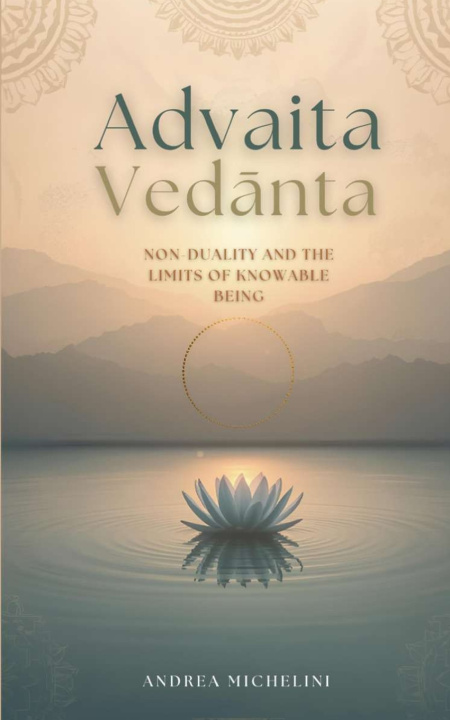
This short essay explores Advaita Vedānta as a philosophical and contemplative perspective on reality, knowledge, and their limits.
Taking up the classical distinction between empirical truth (vyāvahārika satya, practical or conventional truth) and ultimate truth (pāramārthika satya, absolute truth), the work examines how human thought-scientific, philosophical, and religious-operates within an inevitably dual structure.
Non-duality is not presented here as an alternative metaphysical doctrine, but as a dissolution of the very presuppositions that make ultimate questions possible: creation, causality, consciousness, God, the universe.
In this sense, cosmological and theological problems are not solved, but returned to their proper domain of validity.
The text engages in dialogue with Western philosophy, contemporary science, and certain emblematic phenomena of the present age, showing how every form of knowledge is at once necessary and intrinsically limited.
Advaita Vedānta thus emerges not as an answer, but as the horizon within which the very need for answers comes to rest.