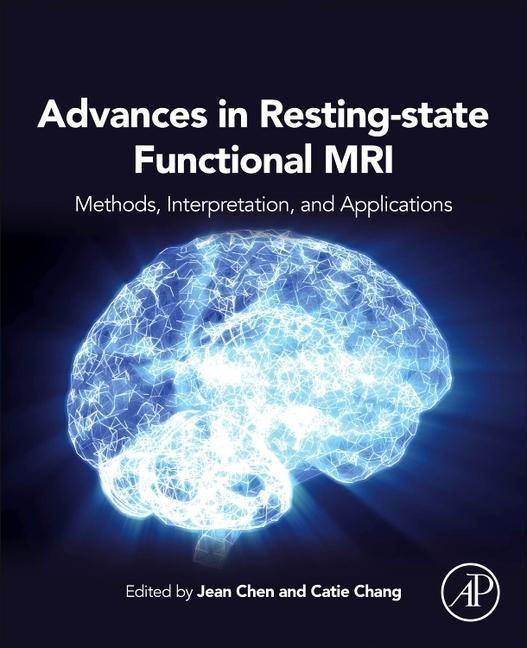
In the past 20 years, resting-state functional magnetic resonance imaging (rs-fMRI) has become the dominant method for mapping human brain networks in neuroscience and clinical research. However, much remains to be understood about how best to acquire and extract such functional-connectivity information.Advances in Resting-state Functional MRI: Methods, Interpretation,and Applications gives the reader, with basic neuroimaging experience, an up-to-date and in-depth understanding of the methods, opportunities, and challenges in rs-fMRI. The book covers current knowledge gaps in rs-fMRI, including "what are biologically plausible brain networks", "how to tell what part is noise", "how to perform quality assurance on the data" to "what are the spatial and temporal limits of our ability to resolve FC" and "how to best identify network features related to individual differences or disease state".Advances in Resting-state Functional MRI: Methods, Interpretation, and Applications is an ideal reference for neuroscientists, computational neuroscientists, psychologists, biomedical engineers, physicists, medical physicists. Both new and more advanced researchers alike will be able to discover new information distilled from the past decade of research and become well-versed in rs-fMRI-related topics. First book to explain and present the latest methods, opportunities and challenges of Resting-state Functional MRI Edited and authored by leading researchers in fMRI Includes neuroscientific and clinical applications