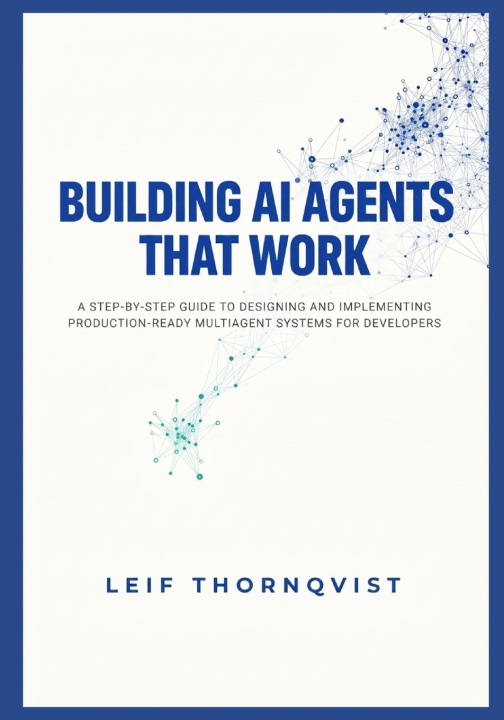
The development of intelligent multiagent systems represents one of the most significant advancements in modern software engineering and artificial intelligence. However, transitioning from proof-of-concept agents to reliable, production-grade systems capable of operating at scale remains a formidable challenge for many development teams. Building AI Agents That Work addresses this gap by delivering a rigorous, engineering-focused methodology for designing, implementing, and maintaining robust multiagent architectures.
Drawing on established principles from distributed systems, software architecture, and contemporary AI research, this guide provides developers with a structured pathway to create agents that collaborate effectively, adapt to dynamic conditions, and deliver consistent value in enterprise environments. Readers will explore the full lifecycle of multiagent system development, from initial conceptualization and agent modeling through sophisticated orchestration, secure tool integration, comprehensive testing regimes, and resilient deployment strategies.
The book emphasizes practical techniques for overcoming common failure modes in agentic systems, including brittle communication, unpredictable emergent behaviors, resource contention, and observability gaps. Detailed coverage is given to production concerns such as fault tolerance mechanisms, performance optimization, security hardening, and governance frameworks that align agent actions with organizational objectives and ethical standards.
Throughout the chapters, readers gain hands-on insights into integrating large language models as reasoning cores, implementing standardized communication protocols, constructing hierarchical and decentralized control structures, and establishing automated evaluation pipelines. Real-world considerations around compliance, auditing, and long-term system evolution are addressed with actionable recommendations.
Designed for software architects, senior backend engineers, AI platform teams, and technical leaders who already possess foundational programming and system design experience, this resource bridges the divide between academic multiagent theory and the pragmatic demands of shipping production software. By applying the methodologies outlined, development teams can significantly reduce iteration cycles, minimize operational risks, and accelerate the delivery of sophisticated AI-powered solutions.
If you are ready to elevate your capabilities in building autonomous, collaborative AI systems that perform reliably under real-world pressures, this book provides the definitive technical foundation.
Acquire your copy now and start constructing multiagent solutions that deliver measurable impact.