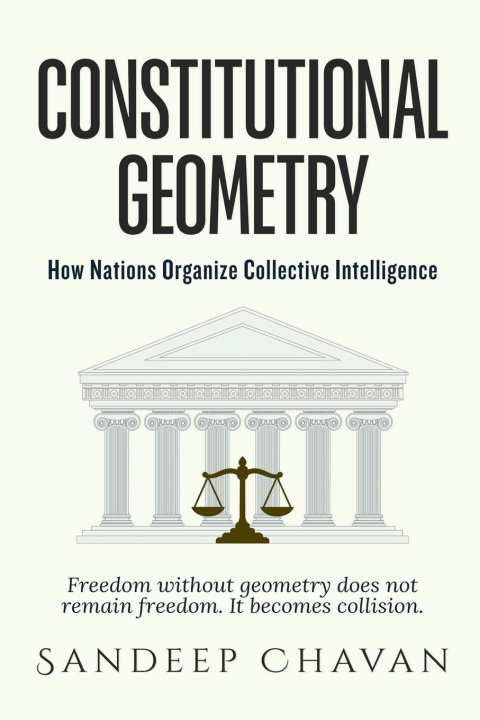
Constitutional Geometry: How Nations Organize Collective Intelligence presents a powerful new lens for understanding constitutions, nations, institutions, citizenship, power, justice, and civilizational harmony.
This book argues that a constitution is not merely a legal document, political contract, or symbolic national text. It is the living geometry through which a civilization organizes its collective intelligence. It gives shape to power, freedom, rights, duties, justice, identity, reform, feedback, institutions, and public consciousness. A constitution does not create an ideal nation. It gives a living civilization the structure required to correct itself without destroying itself.
Sandeep Chavan develops the idea of "constitutional geometry" as the boundary architecture of national life. Through this framework, he explains why intelligence needs constraints, why power naturally expands, why freedom requires responsibility, why rights and duties must remain connected, why justice is not revenge, why reform must not become destruction, and why harmony is the final purpose of constitutional life.
The book moves beyond conventional legal discussion and treats the Constitution as a living civic architecture. It examines the anatomy of constitutional systems: power, rights, duties, institutions, feedback, stability, flexibility, reform, citizenship, and public consciousness. It also identifies deep constitutional distortions: domination disguised as order, chaos disguised as freedom, permanent privilege, permanent victimhood, identity over citizenship, emotional governance, and institutional capture.
A major section of the book studies national models as constitutional geometries. India is explored as absorption geometry, America as competition geometry, China as coordination geometry, Europe as consensus geometry, and failed or fragile states as survival geometry. These models are not treated as objects of praise or condemnation, but as different ways nations organize collective intelligence under historical, cultural, institutional, and civilizational pressures.
The final part of the book turns toward constitutional consciousness. A constitution survives not only in courts, parliaments, laws, or official ceremonies, but in the minds of citizens. Citizens must understand why power needs limits, why freedom needs structure, why institutions must remain independent, why identity must remain under citizenship, and why public emotion must pass through truth and process before becoming governance.
Written for common readers, students, educators, policymakers, researchers, civic thinkers, political philosophers, and constitution writers, Constitutional Geometry offers a serious yet accessible framework for understanding how nations remain stable, fair, free, reformable, and harmonious under pressure.
This book is not a legal textbook. It is a civic and civilizational lens.
Its final thesis is clear: a constitution is not sacred because it is written. It becomes sacred only when it preserves life, dignity, justice, order, freedom, correction, and harmony.