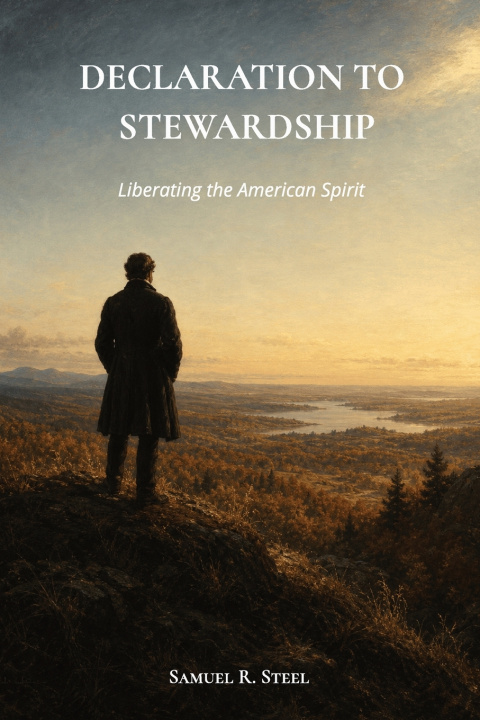
The Declaration of Independence is the most quoted and least honored document in American civic life. Samuel R. Steel's Declaration to Stewardship takes that tension seriously.
Steel's central argument is developmental: the founding generation made a vow before it had the moral and institutional capacity to keep it, and the history of the republic is the story of what subsequent generations chose to do with that gap. The book reads American political history not as a sequence of events but as a maturation arc, measured against the standard the founders set in their own words. Much like the life of an individual, the life and development of a nation grows through phases, and needs to be looked at and treated accordingly.
The development focuses on four stages: The first traces the Enlightenment foundations of the Declaration - Locke, Montesquieu, Paine - and the philosophical confidence that made Jefferson's claims feel self-evident to the men in the room, even as 41 of the 56 signers enslaved other human beings. The second follows the republic's institution-building period: the Constitutional Convention, the early republic's tests of civil liberty, and the slow expansion of who counted as a rights-bearing person under the original promise. The third confronts the republic at midlife - the Civil War as the founding's reckoning with itself, and the temptations of imperial power that followed. The fourth asks what stewardship requires at 250 years: repair of documented wrongs, honest accounting of ongoing failures, and the cultivation of civic virtues that no founding document can guarantee.
Steel writes with a historian's precision and a civic philosopher's care. He takes Lincoln seriously as a reader of the Declaration. He does not resolve the founding contradiction - he insists on holding it open, because a republic that forecloses that tension has stopped growing.
The book is not nostalgic. It does not argue that the founders were better than they were, or that the republic has lived up to its promise. It argues something harder: that the promise is real, the gap is real, and the choice of whether to close it belongs to the living.
For readers who want their American history clear-eyed and morally serious - Declaration to Stewardship is the book written for the nation's 250th year.