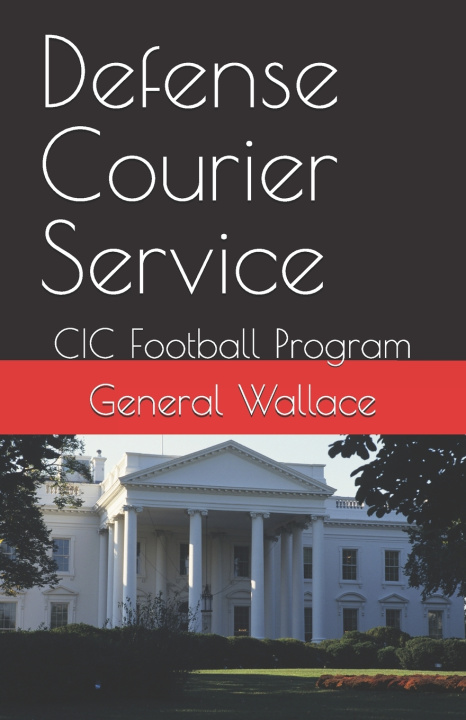
This book gives a first-hand account of the CIC (Commander in Chief) Football Program. The author is one of the few members of the military to serve on the POTUS detail with the Defense Courier Service carrying the Football Program Briefcase. The author explains how every aspect of his life, education, and training contributed to his duties with the Football Program.
Author Bio
Mr. Jon M Wallace earned his AACSB-accredited Global MBA from the University of Texas at Dallas Jindal School of Management. Jindal School of Management is ranked in the top 25 in the United States by several ranking services.
Mr. Wallace's professional career path included work in contract administration, retail merchandising, and motorcycle loan underwriting. While Mr. Wallace did not work in Government Contracting for a long period, he was called in to fire contractors, a distasteful task that other contracting officers did not want to participate in.
He served in the U.S. Military Special Operations Forces Community, where he developed expertise in lifesaving, Signals, Ordnance, Nuclear Command and Control, and CBRN (Chemical, Biological, Radiological, and Nuclear) Defense.
Mr. Wallace attended enlisted leadership academies and technical schools in connection with his role as a counter-intelligence officer. He also worked as an instructor training Marines, SEALs, SEAL Team Six, Rangers, Delta Force, and Green Berets in SERE, Military Intelligence, Counterterrorism, and Counterproliferation.
Mr. Wallace later applied these skills as a Radiation Protection Officer within the Special Warfare Community. Mr. Wallace also worked in the Nuclear Football Program. After leaving active duty in the U.S. military, he leveraged his education and experience into a career as an Operations Officer with the U.S. Government in Counterproliferation (Nuclear Collections Service) and Counterterrorism.
Mr. Wallace works as an Operations Officer and Strategic Consultant, leveraging his broad experience in foreign affairs, special operations, strategy, intelligence, and global security. Guided by his Christian faith, he views his professional and academic pursuits as part of a larger calling to stewardship and service.
Mr. Wallace's research focuses on food systems, food security, supply‑chain logistics, and agroeconomics. Mr. Wallace's recent paper, published in the Regent University Proceedings Journal, analyzes how the production of beer, wine, distilled spirits, and ethanol crowds out global food production by diverting millions of acres of agricultural land away from nutritional crops.
Although the paper does not address nuclear conflict directly, its findings reveal the scale of opportunity cost embedded in current land‑use patterns-most notably that global ethanol production alone represents an opportunity cost equivalent to feeding more than one billion people.
This research becomes especially relevant when considered alongside the potential secondary effects of a nuclear exchange. While the paper itself does not discuss nuclear scenarios, its implications are clear: any disruption to regional, continental, or global food supply chains-such as those that would follow even a limited nuclear exchange-would magnify existing vulnerabilities.
Understanding these opportunity costs now is essential for strengthening strategic resilience and reducing humanitarian risk in an increasingly fragile global environment.
Mr. Wallace began doctoral studies in 2025, but he has been a lead researcher and analyst detailed to the CIA for over 25 years. CIA Papers are peer-reviewed by senior analysts and policy makers. Due to non-disclosure requirements, CIA Researchers rarely publish their papers.