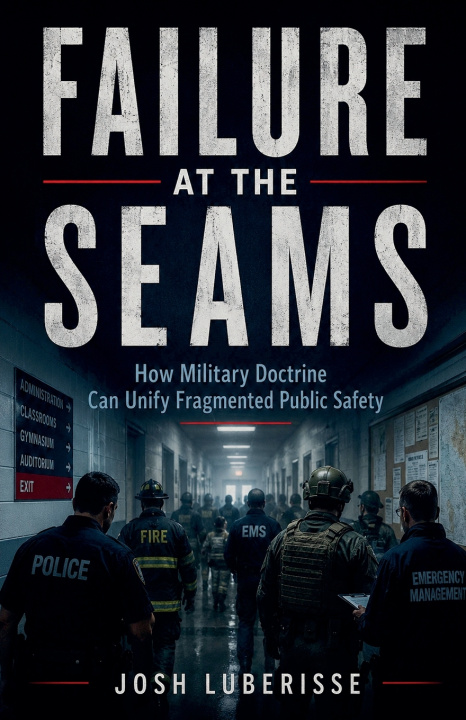
On May 24, 2022, nearly 400 officers from at least four agencies gathered in the hallway of Robb Elementary School in Uvalde, Texas. Every one of them had been trained in incident command. Every one carried the certification. And for seventy-seven agonizing minutes, no one was in charge. Nineteen children and two teachers died on the other side of a door while the largest concentration of law enforcement in Texas stood waiting-not for courage, not for equipment, but for something their training had never given them: the structure to act as one.
Failure at the Seams reveals why this tragedy was not an anomaly-and why the same failure recurs across every major multi-agency disaster in modern American history. From the Twin Towers to Hurricane Katrina, from Parkland to the Boston Marathon, the pattern is relentless: brave, well-trained responders from sovereign agencies converge on a crisis, and the seams between them tear open.
The diagnosis is devastating. America has built the tactical version of jointness-the Incident Command System (ICS), a brilliant framework for managing emergencies once they've begun. But we have never built the institutional version: the career-shaping, culture-forging structure that makes jointness hold when it matters most. We bought the phrasebook. We never built the fluency.
The prescription is honest-and achievable. Drawing on the landmark Goldwater-Nichols Act of 1986, which transformed the U.S. military from a collection of rival services into a unified fighting force, Luberisse shows how the same principles can-and cannot-be applied to American public safety. The military had what public safety lacks: a single principal-one authority that could restructure the entire force by statute. Public safety answers to thousands of sovereigns.
Neither a call for police militarization nor a simplistic reform manifesto, Failure at the Seams offers a sober, realistic, and thought-provoking assessment of why coordination failures persist and what can actually be done to reduce them. It challenges readers to rethink assumptions about local control, emergency response, public administration, and institutional design while providing the men and women who run toward danger the one thing they've never had: a structure that ensures someone is in charge before the catastrophe arrives, not forty-five minutes after.
For readers interested in public safety, homeland security, emergency management, military strategy, public policy, organizational leadership, crisis response, and government reform, Failure at the Seams provides a powerful new framework for understanding why institutions fail under pressure-and how lives can be saved by closing the gaps between them.
"The seam is not a diagram. It is a hallway where children waited while the adults outside argued about who had the authority to go in. It is a stairwell where firefighters never heard the order to leave. It is a flooded street where help was an hour away and a jurisdiction away and might as well have been on the moon. People die in the seams. That is the whole reason this book is worth writing."
Failure at the Seams is essential reading for policymakers, emergency managers, law enforcement leaders, firefighters, and anyone who has ever wondered why the same failures happen again and again-and what it will take, finally, to stop them.