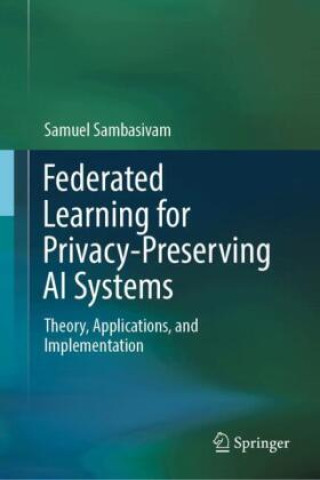
This book provides a comprehensive, single-author treatment of federated learning that unifies its theoretical foundations, privacy-preserving mechanisms, and production deployment considerations. Federated Learning for Privacy-Preserving AI Systems addresses the architecture of horizontal, vertical, cross-silo, and cross-device federated learning; the core algorithms, including FedAvg, FedProx, and their personalized and asynchronous variants; convergence analysis under non-IID data; and the privacy-preserving toolkit that renders federation trustworthy in practice, including differential privacy, secure multi-party computation, homomorphic encryption, secure aggregation, and Byzantine-robust aggregation.
Three application chapters extend the framework to financial systems, cybersecurity for zero-day attack detection, and healthcare diagnostics, each with a documented experimental setup, baseline comparisons, performance analysis, and lessons learned. A design science chapter guides practitioners through requirements analysis, architecture patterns, and deployment, while a cross-domain chapter consolidates results and offers a decision framework for selecting federated rather than centralized approaches.
Graduate students gain a coherent curriculum supported by worked examples and end-of-chapter exercises; researchers gain a unified treatment of privacy and convergence; practitioners gain hyperparameter selection and debugging guidance grounded in real workloads. The book is based on the author s current research and is intended to bridge theoretical foundations and production deployment within a single, pedagogically integrated volume.