Reactive Publishing
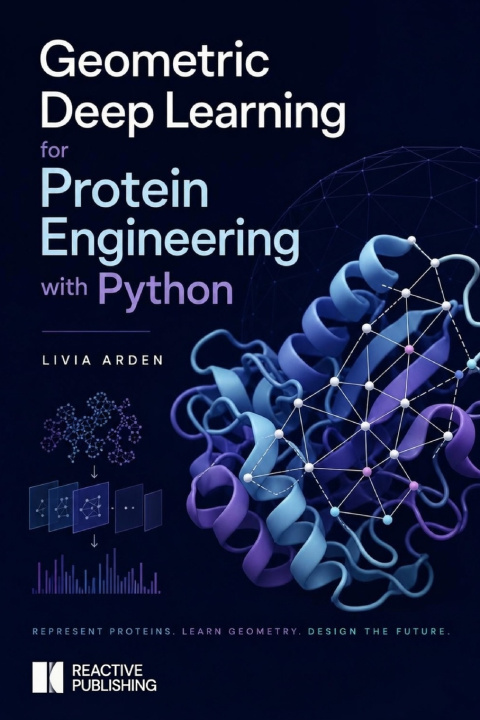
In the rapidly evolving intersection of artificial intelligence and biotechnology, geometric deep learning has emerged as a powerful framework for modeling the complex 3D structures and interactions that define protein function. Geometric Deep Learning for Protein Engineering with Python provides a practical, hands-on guide to applying these cutting-edge techniques to real-world protein engineering challenges.
What You'll Learn
- Core Principles: Master the mathematical and computational foundations of geometric deep learning, including graph neural networks, equivariant architectures, and manifold-based representations tailored to molecular data.
- Python Implementation: Build end-to-end pipelines using popular libraries such as PyTorch Geometric, DGL, and E3NN to process protein structures from PDB files and design novel sequences with enhanced properties.
- Protein Engineering Applications: Learn how to predict protein stability, binding affinity, folding dynamics, and enzyme activity. Explore case studies in therapeutic protein design, antibody engineering, and synthetic biology.
- Advanced Techniques: Dive into diffusion models for protein generation, geometric transformers, and hybrid approaches that combine physics-based simulations with deep learning.
Who This Book Is For
Perfect for computational biologists, machine learning engineers, bioinformaticians, and researchers seeking to bridge deep learning with structural biology. Whether you're a graduate student, industry professional, or experienced Python developer looking to enter the biotech space, this book offers the technical depth and code-first approach you need.
Clear explanations, fully reproducible Python code examples, and progressive exercises make complex concepts accessible without sacrificing rigor. Move beyond traditional sequence-based methods and harness the full power of 3D molecular geometry to accelerate your protein engineering projects.
Start engineering the proteins of tomorrow, today.