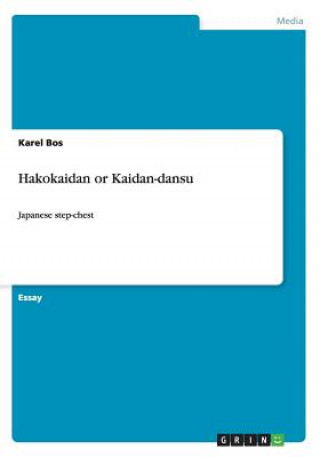
Книга Hakokaidan or Kaidan-dansu Karel Bos

Hakokaidan or Kaidan-dansu

Japanese step-chest

Автор: Karel Bos
Език: Английски език
Корици: С меки корици
Издател: Grin Publishing
Наличност: Външен склад
Изпращаме след 8-11 дни
14.77 28.90 лв
Essay from the year 2012 in the subject Art - Architecture / History of Construction, , language: En...


Информация за книгата

Автор
Език
Английски език
Корици
Книга - С меки корици
Издадена
2014
страници
20
EAN
9783656822820
ISBN
3656822824
Enbook ID
09071528
Издател
Теглоt
54
Размери
178 x 254 x 1

Пълно описание

Essay from the year 2012 in the subject Art - Architecture / History of Construction, , language: English, abstract: The Japanese step-chest (kaidan-dansu or hakokaidan) is inextricably linked with the traditional 'machiya'§in Kyoto. In contrast to the 'minka', which are farmhouses, fishermen's houses and mountain dwellings, the§'machiya' is a merchants' and craftsmen's town-house, specifically in Kyoto, also often called 'kyo-machiya'.§Kyoto 'machiya' are traditional townhouses with distinctive Kyoto-style latticework doors and slatted§second-story windows (fig. 1+2). Machiya are already depicted on 17th century screens and they were still§built during the Taisho period and beyond until about 1936.§These wooden houses, where merchants and artisans both lived and worked, provided a space in front for§a store, in the middle for family quarters with small garden, and in the rear for workshops and warehouses.§Many of them can still be seen in the Gion district and they came to be regarded as one of the typical§traditional structures which characterise the ancient city of Kyoto.§Kyoto, Japan s capital of traditional culture, is one of the few Japanese cities that was spared from the§bombings of World War II, yet every year scores of 'machiya' are destroyed, victims of neglect and urban§redevelopment, thus rapidly erasing the traditional urban fabric. Luckily civic groups in Kyoto are working§hard to save the buildings that remain and to preserve this superb example of Kyoto vernacular architecture.§Typically the 'machiya' has a narrow front of about 5.5 to 6.4 m (3 to 3.5 ken ) and a depth of around 20 m§(11 ken ). As homes were taxed according to the size of the street frontage, this design originated from§economic necessity (fig. 16). However, as merchants became richer, they built larger 'machiya' and it is not§unusual to find a frontage of 6 and 7 ken (12.7 m).§The meaning of the modern concept of the 'module' has an exceptional antecedent in Japan, where for§hundreds of years the ordinary houses have been built on the basis of a modular order which is unique. [...]

Може също да ви хареса

Cities at War

Mary Kaldor
132.90 259.94 лв

Sex Practice

Ray Gordon
9.41 18.41 лв

Antonio Machado

JEREMY GORING
22.29 43.59 лв
10.31 20.17 лв
16.13 31.54 лв
23.59 46.14 лв
13.47 26.35 лв
37.32 72.99 лв

Corporeal Image

D. MacDougall
54.05 105.71 лв
149.03 291.49 лв
112.06 219.18 лв

Клиенти, които купиха тази книга, купиха също

32.96 64.46 лв