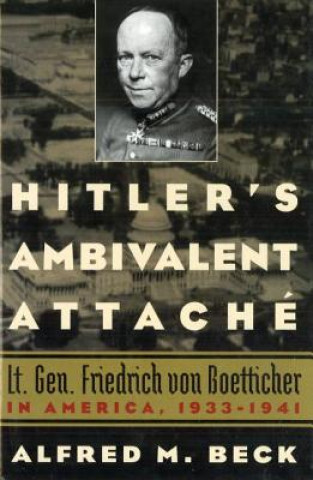
Friedrich von Boetticher was Germany's only military attache accredited to the United States between the world wars. As such, he was Germany's official military observer in the capital of the nation whose potential as an ally of those powers arrayed against Adolf Hitler in the 1930s might have given the dictator pause in any predatory plans he harbored against his neighbors. Though von Boetticher produced a rich and detailed commentary on military and political affairs in Washington in the eight years prior to the outbreak of war between Germany and the United States in 1941, he was nonetheless accused after the war of misjudging America's productive potential and misleading Hitler with overly optimistic reports. As Alfred M. Beck points out, what he actually told German authorities in Berlin is strikingly different from what his detractors later claimed. Von Boetticher "permits a glimpse into the sociology of a conservative officer caste at once assailed by the politics of a regime and the impossibilities imposed on it, its weaknesses in resisting its evils, and its eventual failure to present an alternative to National Socialism's illusory attractions." A loyal German, von Boetticher had strong ties to America. His mother was American-born, he spoke English fluently, and he was enamored of American military history. He was also anti-Semitic and believed that "Jewish wire-pullers" had undue influence over the U.S. government and its policies. His professional ties to U.S. Army officers in the War Department were so strong - supplying them, for example, with details on German air strength and operations during the Battle of Britain in 1940 - that they survived until August 1941 and long after the German ambassador himself had been recalled. Torn between his duty to Germany (though the Nazi regime had attempted to harm his son) and his deep affection for America, von Boetticher stood among the broad middle range of German officials who were neither perpetrator nor victim. From the Preface Lt. Gen. Friedrich von Boetticher was Germany's only military attache in the United States between the two world wars. As such, he was his country's sanctioned military observer in the capital of the nation whose contributions of fresh troops had swung the balance against Germany in the last year of World War I. The United States was therefore a country whose potential as an ally of those powers arrayed against him in the 1930s might have given Hitler pause in any predatory plans he harbored against his neighbors. What the German dictator learned of American military preparedness in diplomatic pouch and cable traffic from the governing center of the United States is therefore a compelling question for historians. This study began with the purpose of evaluating the content and accuracy of assessments of the American Army emanating from the German Embassy in the United States before the war. The much revised work became a fuller biography of the attache once it became clear that the man and his work could not be separated. Von Boetticher produced a rich and detailed commentary on military and political affairs from Washington in the eight years before the American entry into the conflict. The decidedly personal stake he added to his work gave his service a character belying the more simplistic notions about him that appear in much of the literature on German-American prewar diplomatic relations. This work seeks neither to rehabilitate a reputation nor to enlarge upon a secondary figure, but to explore the personal, bureaucratic, and political context in which the attache operated. An examination of von Boetticher's service as an attache offers new comment on one traditional form of intelligence. At the time, this activity relied nearly entirely on human perception and reporting, called Humint in the jargon of students of intelligence gathering. Less emphasized after 1945, the posting of officers to assess foreign establishments gave way to much more exotic technical means in the Cold War atmosphere following the demise of the Axis. The prewar exchange of attaches was also conditioned by diplomatic protocol and nicety, and the record left for the historian has much the same feel as that left for students of traditional diplomatic history. The social setting in Washington in fact ruled much of the effectiveness of members of the foreign establishment there. The common bond among professional military officers, especially those who have faced each other across hostile lines, is also a feature of the story. Von Boetticher brought to this as well an established reputation as a military historian.