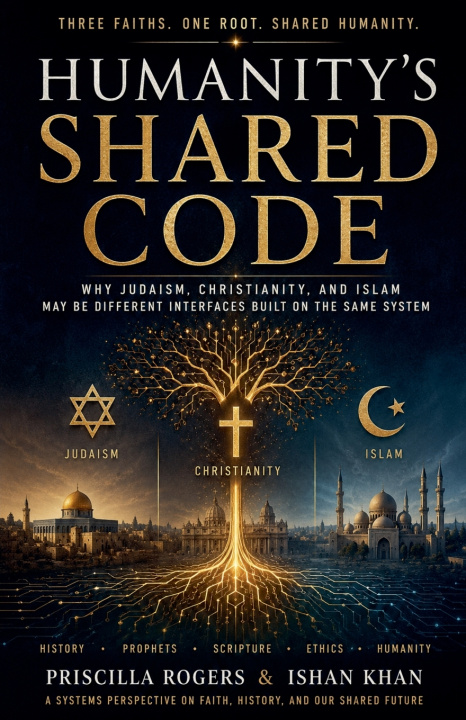
What if Judaism, Christianity, and Islam are not completely separate religions, but different expressions of a shared historical architecture?
In Humanity's Shared Code, authors Priscilla Rogers and Ishan Khan explore one of humanity's oldest and most influential conversations through an unexpected lens: software development.
Using concepts such as source code, updates, forks, documentation, version control, and system architecture, this book examines how three of the world's major religions emerged from common roots while evolving into distinct traditions followed by billions of people today.
Beginning with Abraham and continuing through Moses, Jesus, and Muhammad, the book traces the development of the Abrahamic faiths and explores the shared beliefs, prophets, moral frameworks, scriptures, and historical events that connect them.
Rather than asking which religion is right, Humanity's Shared Code asks a different question:
What can we learn when we examine the architecture beneath the interface?
Written from a respectful, analytical, and non-sectarian perspective, this book is neither a defense of religion nor a critique of it. Instead, it offers readers a framework for understanding how Judaism, Christianity, and Islam relate to one another, where they differ, and why those differences emerged.
Whether you are a believer, skeptic, agnostic, atheist, student, or technology professional, this book provides a fresh perspective on faith, history, culture, and the systems that shape human civilization.
Because sometimes understanding begins when we stop looking at the interface and start examining the code beneath it.