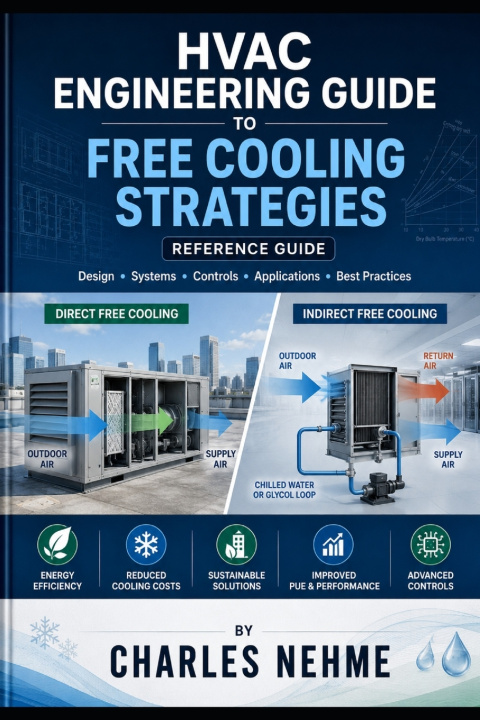
The growing demand for energy efficiency, sustainability, and operational reliability has transformed the way cooling systems are designed and operated in modern buildings and industrial facilities. Among the most effective strategies for reducing energy consumption in HVAC systems is the application of free cooling technologies. By utilizing naturally available low outdoor temperatures, free cooling systems can significantly reduce or even eliminate the need for mechanical refrigeration during favorable climatic conditions.
This book, Direct and Indirect Free Cooling, has been developed to provide engineers, facility managers, consultants, designers, students, and energy professionals with a practical and technical understanding of free cooling applications in modern HVAC systems. As energy costs continue to rise and environmental regulations become increasingly stringent, free cooling has emerged as a key solution for improving system efficiency and reducing carbon emissions across a wide range of industries.
The book explores both direct and indirect free cooling methods in detail. Direct free cooling systems introduce outdoor air directly into conditioned spaces when environmental conditions permit, offering high energy savings and simplified operation. Indirect free cooling systems, on the other hand, utilize heat exchangers and secondary cooling loops to transfer heat without mixing indoor and outdoor air streams, making them highly suitable for critical environments such as data centers, hospitals, laboratories, and cleanrooms.
Throughout this book, emphasis is placed on:
- Energy-efficient HVAC strategies
- Psychrometric analysis and climate considerations
- System design methodologies
- Controls and building management integration
- Indoor air quality and humidity control
- Applications in commercial and mission-critical facilities
- Sustainability and carbon reduction goals
Special attention is also given to the role of free cooling in modern data centers, where cooling energy represents a significant portion of operational costs. With the rapid growth of cloud computing, AI infrastructure, and hyperscale facilities, advanced free cooling technologies are becoming essential components of next-generation cooling design.
This book combines theoretical concepts with practical engineering applications, providing readers with guidance on system selection, design optimization, operational challenges, and future industry trends. Whether the reader is new to free cooling concepts or an experienced HVAC professional seeking advanced knowledge, the material presented aims to support better engineering decisions and more sustainable cooling solutions.
The future of HVAC design will increasingly depend on intelligent, low-energy, and environmentally responsible systems. Free cooling technologies represent a major step toward that future.
- Charles Nehme
CFN-HVAC