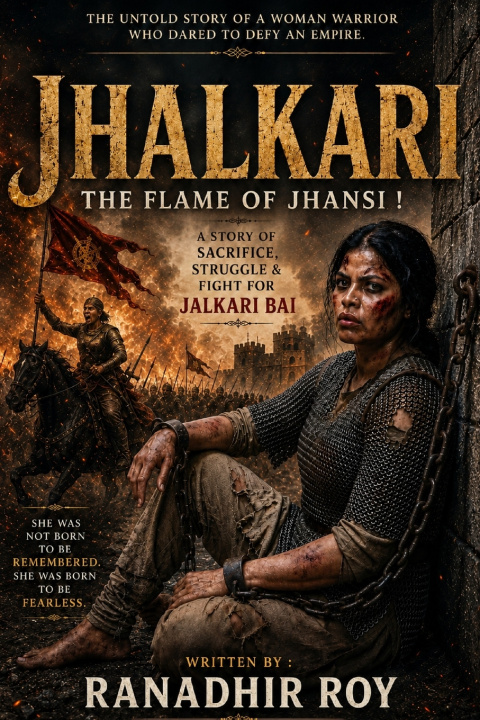
JHALKARI (The Flame of Jhansi)
A Historical Bengali Play by Ranadhir Roy
Jhalkari is not merely a historical play - it is a blazing theatrical uprising against silence, erasure, betrayal, and imperial violence. Set against the backdrop of the 1857 Indian Rebellion, the drama resurrects the forgotten warrior Jhalkari Bai, one of the bravest yet most neglected heroines of Indian resistance history. Through blood-soaked battlefields, political conspiracies, emotional sacrifice, and revolutionary fire, the play transforms history into a living storm upon the stage.
At the center of the narrative stands Jhalkari Bai - a woman born from the soil of Jhansi, forged in struggle, and transformed into an immortal symbol of resistance. As the British Empire tightens its grip around Jhansi under the ruthless command of General Hugh Rose, betrayal begins to spread from within. Kings choose survival over honor, opportunists sell their motherland for power, and trusted men become agents of destruction. Yet amidst this collapsing world, Jhalkari rises like a burning comet.
The play unfolds through a series of intense dramatic sequences - the strategic manipulation of British officers, the moral collapse of collaborators, the martyrdom of revolutionaries, and the emotional devastation of war. Ranadhir Roy crafts a theatrical language where politics becomes poetry, resistance becomes ritual, and death becomes transcendence.
One of the play's greatest strengths lies in its psychological depth. Hugh Rose is portrayed not merely as a military officer but as a terrifying embodiment of imperial intelligence - a modern Ravana with "ten heads" representing war, manipulation, betrayal, fear, greed, law, and psychological domination. Opposing this machinery of empire stands Jhalkari, whose courage gradually evolves beyond human limits into something mythic.
The emotional core of the drama emerges through the tragic death of Puran Kori, Jhalkari's husband and fellow revolutionary. In his final moments, love and revolution become inseparable. His death ignites Jhalkari's legendary vow - to protect Rani Lakshmibai at any cost, even if she must sacrifice her own identity and life. What follows is one of the most powerful acts of resistance in theatrical storytelling: Jhalkari disguises herself as the Queen of Jhansi so the real Lakshmibai can escape and continue the revolution.
The play also gives unforgettable space to the women warriors of the Durga Dal - Moti Bai, Kashi Bai, Mandar Bai, Sundar, Mundar, and countless unnamed fighters whose blood becomes the foundation of freedom. Their deaths are not treated as defeat, but as immortal echoes within the soul of the nation.
Tatya Tope's appearance further expands the revolutionary landscape of the drama. His fiery speeches, battlefield defeat, betrayal by Man Singh, and fearless execution reveal the brutal anatomy of colonial rule and the eternal spirit of rebellion that refuses to die.
The final scenes elevate the play into a symbolic and almost spiritual dimension. Jhalkari, captured and tortured by the British, refuses to surrender the location of Rani Lakshmibai. Even while chained, humiliated, and dying under the whip, she laughs at the empire. Her body breaks, but her spirit multiplies. In death, Jhalkari transcends individuality and becomes an eternal revolutionary consciousness carried forward by future generations.
The play combines realism, poetic monologues, stylized war choreography, ritualistic movement, music, slow motion sequences, projections, and mythological symbolism. The use of Shiva's Tandava, Ravana imagery, revolutionary chants, battlefield rhythms, and haunting visual metaphors creates an epic theatrical experience that merges folk energy with political theatre.