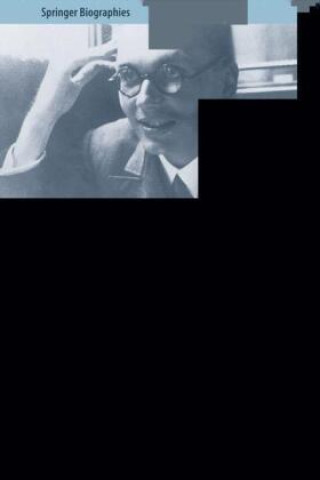
During his lifetime, Kurt Gödel was not well known outside the professional world of mathematicians, philosophers and theoretical physicists. Early in his career, for his doctoral thesis and then for his Habilitation (Dr.Sci.), he wrote earthshaking articles on the completeness and provability of mathematical-logical systems, upsetting the hypotheses of the most famous mathematicians/philosophers of the time. He himself delved into philosophy, attending the meetings of the famous Wiener Kreis early on and later writing many published and unpublished essays on philosophical topics. He spent the last half of his life at the Institute for Advanced Studies in Princeton, as a colleague of Einstein, von Neumann and other notables.He was considered to be a 'curious character' by many of his contemporaries, but had a close friendship with Albert Einstein during the last 15 years of the latter's life. That friendship led him to find a new solution to Einstein's gravitation equations, describing a rotating cosmos called "Gödel's Universe", which exhibits the possibility of time travel. His lifelong fear of poisoning led to his relatively early death by starvation. After his passing, he became a figure of great public interest, not least owing to the book " Gödel, Escher, Bach " published by Douglas Hofstadter a year after Gödel's death. Kurt Gödel has continued to be the object of biographical and professional research and publications by historians of science, mathematicians, philosophers and computer scientists. Although several biographies have been published since his death, they were mostly written by specialists - and often for specialists, emphasizing a particular aspect of his life and work, and they appeared over the period from 1985-2006, more than 15 years ago, so that a new work is certainly justified. In addition, most of the older biographies are not available in digital form; and most importantly, a scientific biography that is accessible to a general audience is overdue. The definitive and well-researched work of John W. Dawson (1997) is now already 25 years old. This book includes more details about the context of Gödel's life than are found in previous biographies, and also spends less time covering his mathematical/scientific/philosophical works, which have been described in great detail in previous books. In this way, it intends to make him and his times more accessible to general (well-informed) readers, and to allow them to appreciate the lasting effects of Gödel's contributions (this last in a more up-to-date context than in other biographies, most of which were written 15-25 years ago). His work spans or is relevant to a wide spectrum of intellectual endeavor, and this is emphasized in the book, with recent examples.