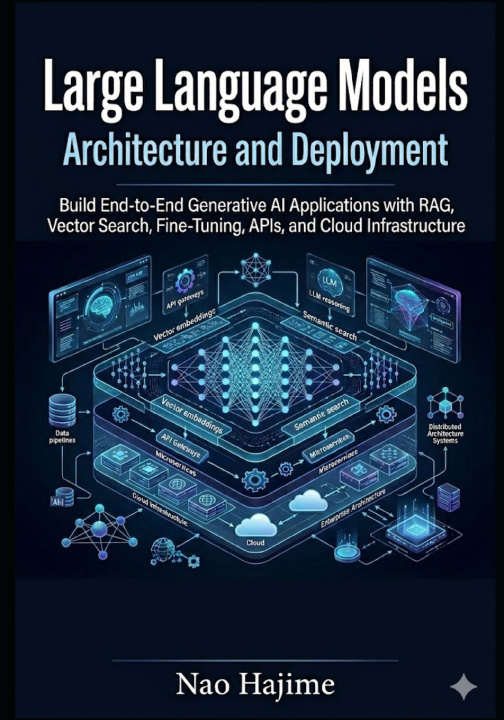
Building modern AI applications requires far more than connecting a language model to a chatbot interface. Production-grade Large Language Model systems demand scalable infrastructure, optimized inference pipelines, reliable data engineering workflows, secure deployment architectures, observability frameworks, and carefully engineered Retrieval-Augmented Generation (RAG) systems capable of delivering accurate and context-aware responses in real-world environments.
LLM Architecture and Deployment is a comprehensive engineering-focused guide to designing, building, deploying, scaling, and maintaining production-ready Generative AI systems powered by Large Language Models. Written for software engineers, AI practitioners, platform architects, DevOps engineers, and technical professionals, this book provides practical insight into the complete lifecycle of modern LLM application development, from infrastructure planning and vector search pipelines to deployment automation and enterprise-scale AI operations.
The book begins by introducing the architecture of production-grade AI systems and the engineering principles required to build scalable and modular LLM applications. Readers will explore modern AI infrastructure design patterns, distributed architectures, orchestration strategies, cloud-native deployment models, and scalable backend systems capable of supporting high-throughput inference workloads.
As the book progresses, readers will learn how to build Retrieval-Augmented Generation pipelines using vector embeddings, semantic search, chunking strategies, metadata enrichment, hybrid retrieval systems, and re-ranking architectures. The book also provides deep technical coverage of prompt engineering, context management, embedding pipelines, vector databases, API development, AI agents, memory systems, autonomous workflows, and multi-agent orchestration frameworks.
Practical deployment topics are covered extensively, including containerization, Kubernetes orchestration, GPU acceleration, quantization, inference optimization, distributed serving, load balancing, CI/CD pipelines, infrastructure automation, cloud deployment strategies, and real-time streaming architectures. Readers will also explore advanced engineering topics such as observability systems, hallucination monitoring, prompt validation, security hardening, governance frameworks, cost optimization, and enterprise AI reliability engineering.
In addition to implementation-focused workflows, the book examines the operational realities of maintaining large-scale AI platforms, including compliance requirements, adversarial attacks, scaling challenges, deployment resilience, infrastructure monitoring, and long-term maintainability of rapidly evolving Generative AI ecosystems.
By the end of this book, readers will have the technical knowledge and practical engineering expertise necessary to design and deploy scalable, production-grade LLM applications capable of supporting enterprise workloads, intelligent AI agents, semantic retrieval systems, and modern Generative AI platforms operating in real-world production environments.