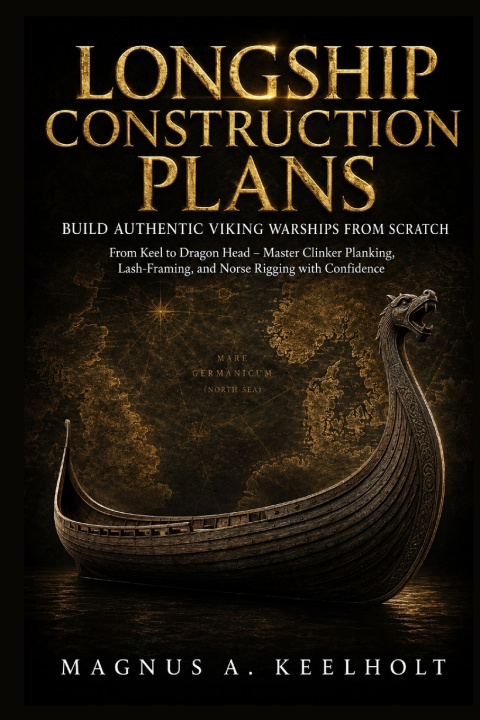
Build a Longship That Honors the Original Shipwrights-Not Another Simplified Kit
You've studied the museum ships. You've felt the gap between what the kits deliver and what your eye knows is missing. This book closes that gap.
Most commercial longship models are engineered for mass production, not historical truth. The keel profile is flattened for easy packaging. The planking lacks the organic variability of real Norse timber. The rivet spacing is mechanically uniform, erasing the responsive rhythm that gave the originals their legendary ability to flex in a North Sea swell. You have invested hours into builds that never quite captured the coiled, predatory grace of the vessels in the Roskilde hall. The frustration is not a lack of skill. It is a lack of the right information-until now.
Longship Construction Plans is a craftsman's field manual, written for model builders who refuse to settle for simplified compromises. Drawing on archaeological evidence from the Skuldelev, Gokstad, and Oseberg ships, this guide walks you through every stage of construction with the precision the original shipwrights brought to their trade. You will learn to read the bones of surviving vessels, translate museum plans into working templates, and build a hull whose authenticity is evident at a glance.
Inside, you will discover:
• The Four Non-Negotiable Elements of an Authentic Silhouette: Master the sheer line, beam-to-length ratio, asymmetrical stem profile, and low freeboard that define the longship from any distance.
• A Minimalist's Toolkit for the Serious Craftsman: Work with a small, high-quality set of hand tools-scalpel, razor saw, clamps, and files-without expensive gadgets that distance you from the material.
• Timber Selection Rooted in Archaeological Practice: Choose quarter-sawn stock that honors the radially split planks of the originals, and learn why grain orientation determines everything.
• Clinker Planking from Garboard to Sheer: Shape the bevels, cut the rabbet, and hang each strake with the organic precision that mass-produced kits erase.
• The Lash-Framing System That Breathed with the Sea: Replicate the spruce-root lashings and naturally curved frames that allowed the hull to flex rather than fracture.
• Carving the Dragon Head with Stylistic Integrity: Decode the visual language of Oseberg, Borre, and Urnes ornament to create a figurehead rooted in the archaeological record.
• Weathering and Display for Museum-Quality Presence: Apply layered salt-spray patinas and mount your vessel on a base that tells the right story.
The Digital Archive: The final section includes a Quick-Reference Cheat Sheet-scale conversion tables, a timber selection chart by ship component, and a curated directory of museum ships worldwide where you can study the surviving vessels in person. No filler. Only references you will use at the workbench.
The Norse shipwrights are gone, but their ships survive-in museum halls, in excavation reports, and in the hands of builders who refuse to let the tradition die. If you are ready to stop assembling simplified kits and start reconstructing history with the integrity it demands, your keel is waiting.