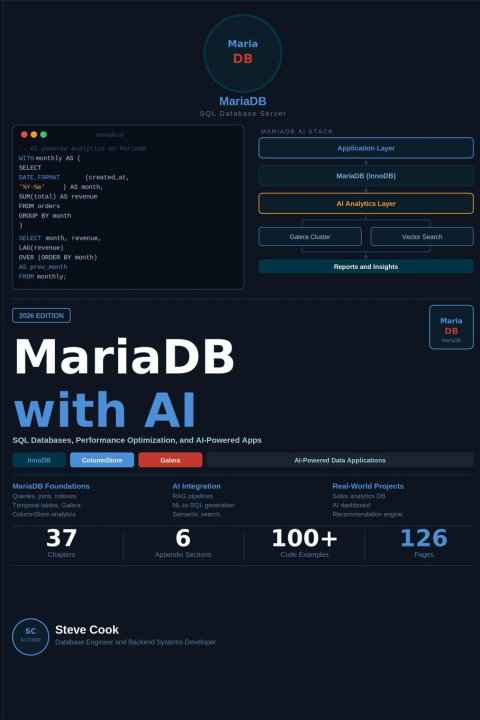
Master the world's most popular open-source MySQL-compatible database - and learn to build AI-powered data applications on top of it, from the ground up.
MariaDB with AI takes you from your very first SQL query through advanced query optimization, window functions, full-text search, replication, and cloud deployment - and then into integrating modern AI APIs to build intelligent, data-driven applications. Written for the 2026 ecosystem, every chapter is practical, current, and built around real-world scenarios.
MariaDB powers Wikipedia, Google, and the European Commission. It ships features years ahead of MySQL, is always fully open source with no commercial edition lock-in, and includes Galera Cluster and ColumnStore analytics built right in. This book teaches you not just how to use it, but how to use it well - and how to make it intelligent.
What you will learn:
- Install and configure MariaDB on macOS, Linux, and Windows
- Write powerful SQL - filtering, sorting, aggregating, joins, subqueries, and CTEs
- Design normalized, scalable database schemas from scratch
- Master advanced features: window functions, JSON support, full-text search, and temporal tables
- Secure, back up, replicate, and monitor production MariaDB systems
- Optimize query performance with indexes, execution plans, and tuning strategies
- Integrate AI APIs and LLMs directly into MariaDB-powered applications
- Use AI to generate, review, and optimize SQL queries
- Build semantic search, AI-powered analytics, recommendation engines, and intelligent data pipelines
- Complete five real-world projects from a sales analytics database to an AI-assisted monitoring platform
Four parts, zero padding:
Part I builds your SQL and MariaDB foundation - tables, queries, joins, indexes, transactions, normalization, and performance basics. Part II covers advanced topics including query optimization, window functions, JSON, full-text search, security, replication, cloud deployment, and scaling strategies. Part III connects MariaDB to the AI era with practical chapters on LLM integration, AI-assisted query generation, prompt engineering for database tasks, semantic search, and intelligent recommendation systems. Part IV delivers five complete guided projects you build from start to finish.
The book includes a MariaDB quick reference, a data type decision guide, an index strategy reference, a configuration reference, and a common errors and fixes appendix - everything you need in one place.
Whether you are building a web application backend, a reporting dashboard, a recommendation engine, or an enterprise data pipeline, this book gives you the database skills and AI integration knowledge to do it right.
Perfect for: developers and analysts new to databases, backend engineers moving from MySQL, data professionals who want to add AI capabilities to their database workflows, and anyone building data-driven applications in 2026.