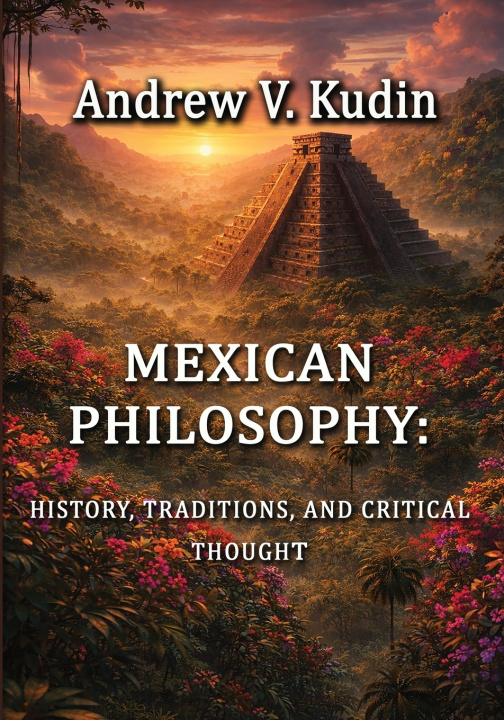
A College-Level Textbook from Indigenous Foundations to Chicano Philosophy
This textbook treats Mexican philosophy not as an appendix to European thought, but as a field with its own arguments, pressures, and conceptual power. It challenges the assumption that Latin American thought is merely derivative, presenting it instead as a dynamic tradition of resistance, synthesis, and rigor.
The book shows how philosophical problems in Mexico took shape under colonial rupture, cultural mixture, and recurring struggles over authority. It tracks how concepts were built and contested in concrete historical settings, where ideas were not ornaments but instruments of critique, survival, and institutional design.
Spanning more than five centuries, the volume provides a structured framework for students to analyze key stages of development:
Indigenous Traditions: Nahua ontology and the aesthetic-ethical ideal of in xochitl, in cuicatl ("Flower and Song"), alongside Maya reflections on cyclical time and mathematical order.
The Colonial Synthesis: The architecture of New Spanish Scholasticism, Jesuit humanism, and the intellectual defiance of Sor Juana Inés de la Cruz.
The Critical Turn: The nineteenth-century struggle between Liberalism and Conservatism, and the rise of Positivism as a framework for education and modernization.
Modern Critical Thought: The search for lo mexicano, Octavio Paz and the problem of identity, the Philosophy of Liberation, and contemporary horizons of Chicano philosophy and border thinking.
Pedagogical Features and Scholarly Precision
Written for students, instructors, and serious readers, this book offers a clear historical arc and a sharp conceptual spine. It is built on verified translations and direct engagement with primary texts, allowing readers to trace specific arguments about hierarchy, freedom, and human dignity.
Mexican philosophy appears here as a distinct tradition of critical inquiry-one that asks, under changing forms of power, what it means to reason, to belong, and to live upright.