Every serious interior tradition has approached the same ground. The Gnostics came closest before they were exterminated. John's prologue names the mechanism precisely, though John arrived late to a conversation that had been underway for considerably longer. The Vedantic non-dualists identified the correct destination but drew the wrong conclusions about the nature of the arrival. The alchemists encoded the structural logic in a symbolic vocabulary that has taken centuries to decode with sufficient precision to be usable.
What none of them said plainly is this: the cosmic process and the personal psychological process are not analogous to each other. They are the same process. The individual who moves through the nigredo of genuine interior crisis, who holds the complexio oppositorum of his own unintegrated opposites, who arrives at genuine coniunctio in his own psyche - that person is not performing a personal imitation of a larger cosmic process. He is the cosmic process expressing itself at the scale available to him. What is true of one is structurally true of the other, and the work done at the personal scale is a literal contribution to the process at the cosmic scale, not a metaphorical one.
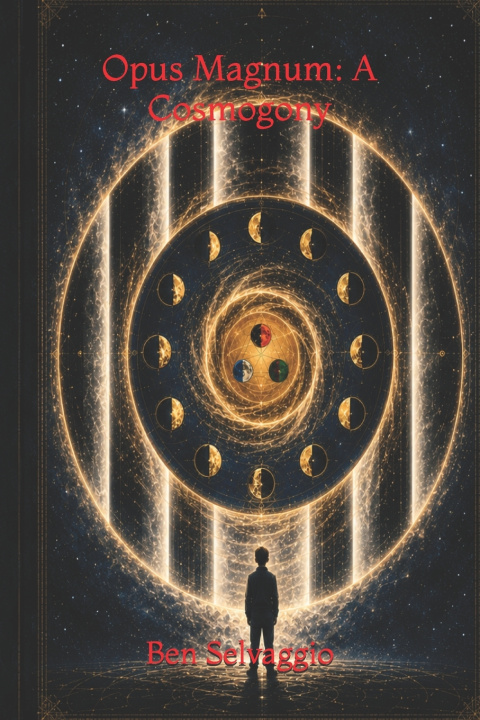
Opus Magnum: A Cosmogony maps the five stages of the Great Work - massa confusa, coincidentia oppositorum, complexio oppositorum, coniunctio oppositorum, unio mystica - operating simultaneously at the cosmological and the personal scale. It describes what consciousness is, why it differentiated, what the 3D simulation is for, why crisis is a mechanism rather than a punishment, what the return actually produces that the undifferentiated ground did not contain, and why the drop does not simply dissolve back into the ocean but adds something to it that could not have existed without the specific resistance of the particular path it traveled.
The map is not the territory. But the territory has been visited, and the map is honest about what was found there.
The fifth volume in The Alchemical Works series.