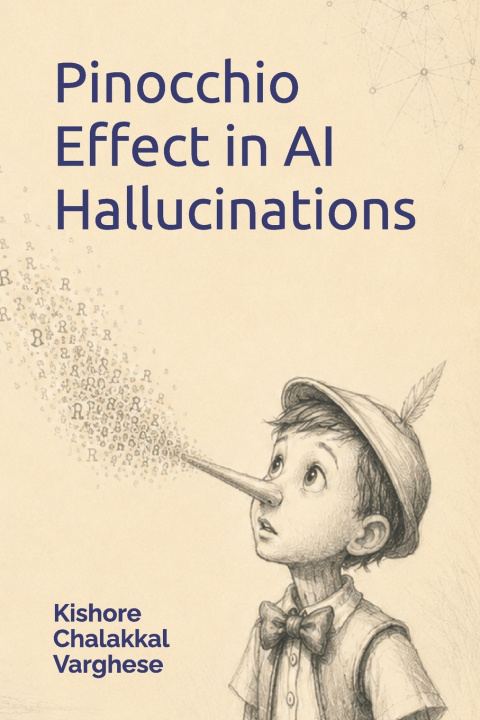
What happens when an artificial intelligence system produces an answer that is fluent, convincing, and completely wrong?
Large language models can explain complex subjects, summarize documents, generate code, and support professional decisions. Yet the same systems can also invent facts, fabricate references, misinterpret sources, and present uncertainty as confidence.
This book examines that problem through the concept of the Pinocchio Effect: the tendency of AI-generated language to appear knowledgeable and trustworthy even when its factual foundation is weak or absent.
Written for professionals, researchers, managers, students, and technically curious readers, The Pinocchio Effect explains how large language models generate language, what AI hallucinations are, why they occur, how they can be detected and measured, and how their risks can be reduced through retrieval, verification, human oversight, and governance.
The book moves beyond the simplistic idea that AI either "understands" or "lies." Instead, it presents hallucination as a system-level problem involving models, data, interfaces, users, and organizational responsibility.
Its central message is simple:
A convincing answer is not the same as a verified answer.
As generative AI becomes increasingly embedded in business, education, healthcare, engineering, law, and public administration, the ability to distinguish fluency from evidence is becoming an essential professional skill.
The Pinocchio Effect offers a clear, practical, and technically grounded guide to understanding that challenge-and to building AI systems worthy of calibrated trust.