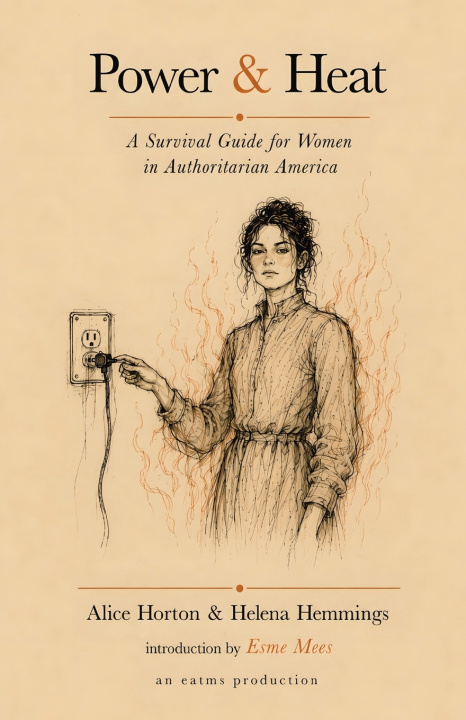
Power & Heat is the first book in the EATMS Productions Infrastructure series, a practical survival guide for women trying to understand the systems that keep a home livable when electricity, heat, utility access, and basic reliability can no longer be taken for granted. This book begins with the ordinary household moment when the lights flicker, the furnace stops, the utility bill jumps, or a shutoff notice arrives, then moves outward to explain the larger machinery behind those private emergencies: the grid, heating systems, utilities, landlords, public regulators, extreme weather, aging infrastructure, and the political choices that decide who gets protected and who is left to absorb failure.
Written by Alice Horton and Helena Hemmings, with an introduction by Esme Mees, this book explains power and heat as survival infrastructure, not conveniences. It covers how electricity reaches the home, why outages happen, how heating systems depend on fuel and electricity, what shutoff notices actually mean, how blackouts change after the first few hours, why heat waves are household emergencies, how to read utility bills, what backup power can and cannot do, and how caregiving changes every calculation. The final chapter, The EATMS Power Plan, helps readers build a realistic household power and heat plan from actual conditions rather than fantasy preparedness.
This is not a prepper manual, technical grid book, FEMA pamphlet, or lifestyle guide about home efficiency. It is a women-centered infrastructure survival guide for authoritarian America: a field guide to what happens when public systems weaken, private costs rise, utilities become harder to trust, landlords defer repair, heat becomes dangerous, bills become unmanageable, and the burden of keeping people alive keeps landing inside the home. As part of the EATMS Productions catalog of survival guides, systems analysis, and social criticism, this volume gives readers a practical method for identifying household dependencies, locating responsibility, documenting problems, and refusing shame for failures built far above the household level.
For readers interested in infrastructure, power outages, utility bills, heating systems, blackouts, energy burden, grid reliability, utility shutoffs, heat waves, renters' rights, caregiving risk, backup power, household safety, carbon monoxide, data centers, AI energy demand, public systems, women's survival guides, authoritarian America, and practical systems analysis, Power & Heat offers a clear, blunt, women-centered guide. It does not promise total control. It gives readers a clearer map of what depends on electricity and heat, what to check before crisis, what to do when systems fail, and what not to waste energy blaming themselves for.