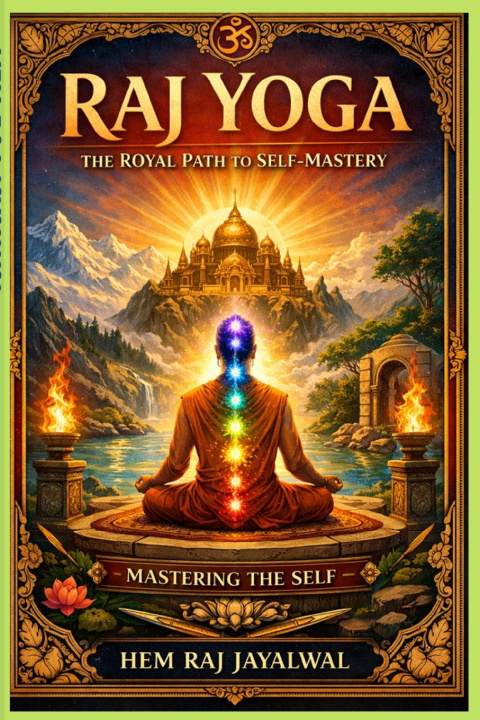
RAJ YOGA
THE ROYAL PATH TO SELF-MASTERY
MASTERING THE SELF
Every tradition of self-mastery has its own name for the summit, but few carry the quiet authority of Raja Yoga - the "royal path". Codified by the sage Patanjali in the Yoga Sutras, this system addresses something far more fundamental than physical posture: the direct training and stilling of the mind itself. Raja Yoga: The Royal Path to Self-Mastery offers a complete, accessible guide to this ancient psychological technology, written for readers who may have only ever encountered "yoga" through the postural fitness culture that now dominates its popular image.
The book opens by correcting this widespread misconception, distinguishing Raja Yoga clearly from Hatha Yoga and situating it among the four classical paths - Karma, Bhakti, Jnana, and Raja - each suited to a different temperament, with Raja Yoga working most directly on the instrument of experience itself: the mind. From there, the book builds a careful map of mental architecture - chitta, manas, buddhi, and ahamkara - before arriving at Patanjali's central claim: that yoga is nothing other than the cessation of the mind's ceaseless fluctuations, the vrittis that keep ordinary awareness in constant, churning motion.
The heart of the book is a sustained, chapter-by-chapter exploration of the eight limbs (ashtanga) - the systematic path from ethical restraint through ultimate absorption. Beginning with yama and niyama, the ethical and personal foundations without which deeper practice cannot stabilise, the book moves through asana (the original, modest meaning of a stable meditative seat, not athletic postures), pranayama (breath as the bridge between body and mind), and pratyahara (the deliberate withdrawal of the senses). It then traces the progressive deepening of attention through dharana (concentration), dhyana (meditation), and finally samadhi - the dissolution of the boundary between observer and observed.
No honest account of this path ignores its difficulties. A dedicated section addresses these directly: the five kleshas, the root afflictions of ignorance, egoism, attachment, aversion, and the fear of death that generate the chain of ordinary suffering; the nine antarayas, the practical obstacles - doubt, laziness, illness, and instability - that interrupt sustained practice; and the deeper mechanics of karma and samskara, the accumulated mental impressions that shape habitual tendency and the patient methods by which sustained practice gradually loosens their grip.
The book's final section turns from theory to integration. It examines the philosophical foundation of Sankhya - the distinction between purusha (witnessing consciousness) and prakriti (active, changing nature) - that underlies the entire system, addresses the siddhis (extraordinary powers) and Patanjali's own firm warning against pursuing them, and offers concrete guidance for living this path through ordinary work, relationships, and decision-making, without requiring monastic withdrawal. A dedicated chapter places the tradition in conversation with modern cognitive science and therapeutic mindfulness, honestly identifying both genuine convergence and meaningful philosophical divergence. The book closes with kaivalya, the path's ultimate fruit: freedom understood not as something constructed through effort but as the recognition of a sovereignty that was, quietly, never actually absent.
Complete with a guided practice combining all eight limbs, a glossary of Sanskrit terms, and a tiered daily practice schedule for beginning, intermediate, and advanced practitioners. A reference guide to key sutras, this book serves equally as a thoughtful introduction for newcomers and a structured companion for those already on the path - offering not a foreign destination to strive toward but a quiet, practical method for governing the one kingdom that has always been rightfully one's own.<...