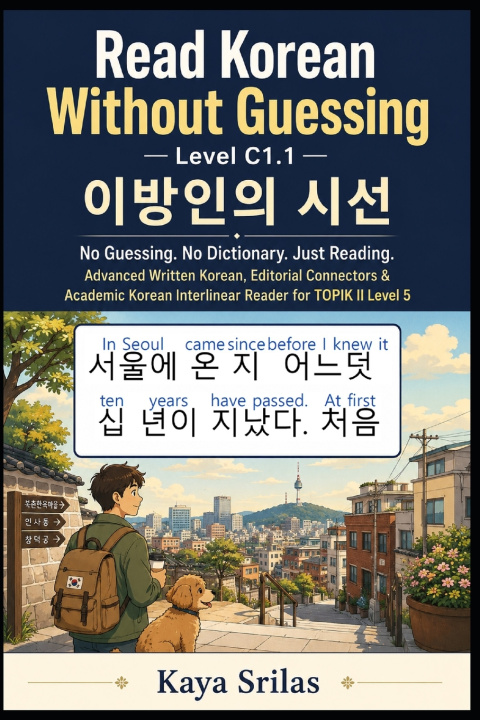
Read Korean Without Guessing - Level C1.1
이방인의 시선 - The Outsider's Gaze
Korean now becomes the language of ideas: essays, editorials, public talks, social change, art, memory, and belonging.
Lucas is no longer simply describing life in Seoul. He is learning to think on paper - to argue, define, question, qualify, and guide the reader through advanced written Korean.
No Guessing. No Dictionary. Just Reading.
This ninth book in the Read Korean Without Guessing series begins TOPIK II Level 5 and moves learners into C1-level Korean: formal, abstract, journalistic, and academic.
Each chapter gives you Korean with interlinear English support, then a Korean-only version so you can test yourself without stopping to search, guess, or break the flow.
What Makes Level C1.1 Different?
Level B2.2 introduced written 한다체 and complex connectors. Level C1.1 takes the next step: sustained argument.
You will meet essay grammar - patterns Korean writers use to define ideas, frame debate, describe large-scale change, and challenge received wisdom.
- Inevitability: −(으)ㄹ 수밖에 없다, −지 않을 수 없다, −기 마련이다
- Definition: −에 다름 아니다, −에 불과하다, −(으)ㄹ 뿐이다
- Possibility: −(으)ㄹ 법하다, −기 십상이다, −기 어렵다
- Framing: −을/를 둘러싸고, −에 관해서, −에 대해서
- Correlation: −에 따라, −와/과 더불어, −을/를 바탕으로
- Connectors: 따라서, 그러므로, 즉, 반면, 다만, 요컨대
The Story Continues
After publishing his photo book in B2.2, Lucas is invited to write a regular column. He reflects on Seoul's redevelopment, photography, tradition and modernity, and the difficult idea of home for someone born elsewhere.
The learner who once struggled with daily Korean now writes about 재개발, 가치관, 시각, 상식, and 표현. Through his outsider's gaze, you learn to read Korean as argument, not just story.
Inside This Book
- 10 advanced chapters in formal 한다체
- 2000-2500 words per chapter with native-style complexity
- Hangul only; Hanja begins later at C1.2
- 6000-8000 cumulative words across social, artistic, and academic themes
- Interlinear + Korean-only reading in every chapter
- TOPIK II Level 5-style practice
You Will Learn To Read
By the end, you will follow advanced Korean prose with greater confidence: opinion columns, accessible academic writing, cultural criticism, speeches, and essay-style arguments.
- Express what cannot but happen: 도시는 변할 수밖에 없다
- Define ideas: 사진이란 기억의 기록에 다름 아니다
- Frame controversies: 재개발을 둘러싸고 논쟁이 계속되고 있다
- Describe social change: 경제 성장에 따라 거리가 변했다
- Question assumptions: 태어난 곳이 반드시 고향은 아니다
- Build arguments: 따라서, 그러므로, 즉, 반면, 다만
Built for Serious Korean Learners
This book is for learners ready to move beyond sentence-level understanding into the real structure of Korean prose. The sentences are longer. The vocabulary is denser. The grammar is more abstract. But the interlinear method keeps the meaning visible.
You will practice a key strategy: find the final predicate first, then work backward through modifiers and clauses. Korean is head-final, and this book trains you to read that structure with confidence.
A Complete C1 Reading Experience
Alongside the story, you receive support for advanced formal patterns, academic connectors, Sino-Korean vocabulary, register awareness,