With legal ethics in the national spotlight, this first-of-its-kind, AI-assisted investigation reveals an attorney discipline system that is secretive, inconsistent, unfair, and obsessed with the "business of law." The same AI, the book argues, holds the promise to reinvent attorney discipline and the justice system itself.
The Massachusetts Board of Bar Overseers promises "to protect the public from unethical conduct by attorneys." In a typical year, it "resolves" 96% of the complaints it receives without opening an investigation, usually within 45 days and never with a written explanation.
In Slot Machine Justice, a physician, healthcare analyst, and analytics entrepreneur uses AI to examine 24 years of attorney-discipline decisions in Massachusetts. By turning more than 4,000 unstructured legal decisions into a structured dataset, he asks a simple question: does the disciplinary system do what it claims?
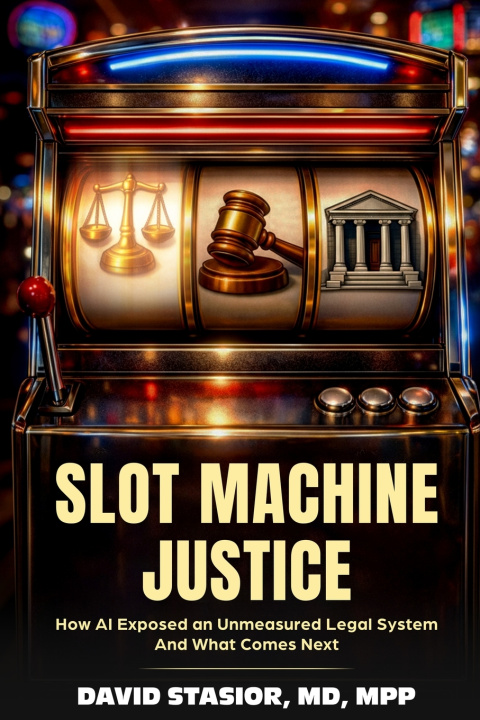
The answer reads less like blind justice and more like a slot machine.
Similar misconduct produces wildly different outcomes. Mitigating factors, aggravating factors, conditions, and other case characteristics are inconsistently associated with the final sanction. The institution charged with protecting the public focuses heavily on the mechanics of running a practice-bookkeeping most of all-while substantive legal ethics play a far smaller role. Counting only the most serious sanctions-suspension or worse, for legal misconduct arising in Massachusetts-discipline reaches a lawyer roughly once per thousand years of practice.
The author came to the project as both an analyst and a defendant. While facing a federal criminal case of his own, he went looking for how similar cases had been resolved-and found that the justice system, despite the mountains of documents it generates, had never organized those documents into something ordinary people could use. Attorney discipline became the proof of concept: with the help of AI, thousands of scattered legal records are transformed into a structured dataset of how a system actually behaves.
But this book is about far more than one disciplinary board. It is a blueprint for the future of the legal system itself.
The same AI that exposed these patterns can be applied to the courts, moving the law away from adversarial gamesmanship and toward data-driven improvement. The author proposes concrete next steps for improving both attorney discipline and the judicial system.
Part personal narrative, part data sleuthing, and part public-accountability investigation, Slot Machine Justice does not ask readers to take its conclusions on faith. Hundreds of cited cases let them check the work themselves.
A citizen with data held an institution accountable. This story shows what he found, how he measured it, and how the same approach could finally make the justice system answerable to the people it serves.