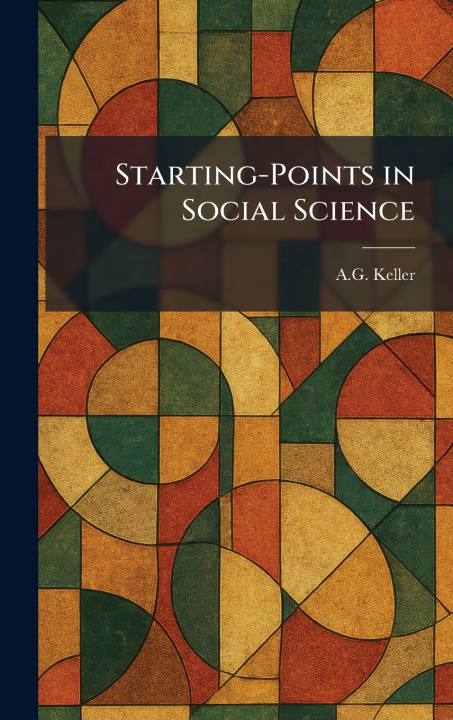
"Starting-Points in Social Science" offers a comprehensive introduction to the foundational elements of sociology and the study of human society. Written by the distinguished scholar A.G. Keller, this work serves as an essential guide to understanding the origins and development of social institutions. Keller explores the basic components of human association, examining how various factors-ranging from environmental influences to collective habits-shape the evolution of cultures and civilizations.
The text provides a clear and systematic overview of the forces that drive social change and the structures that maintain societal order. By delving into the 'starting points' of human interaction, Keller illuminates the transition from primitive social forms to complex modern organizations. This work is characterized by its analytical rigor and its commitment to applying scientific principles to the study of human behavior.
Ideal for students of sociology, anthropology, and history, "Starting-Points in Social Science" remains a significant contribution to the field. It invites readers to reconsider the fundamental principles of social life and the historical trajectory of human progress. This book is a valuable resource for anyone seeking a deeper understanding of the mechanisms that underpin the social world.
This work has been selected by scholars as being culturally important, and is part of the knowledge base of civilization as we know it. This work was reproduced from the original artifact, and remains as true to the original work as possible. Therefore, you may see the original copyright references, library stamps (as most of these works have been housed in our most important libraries around the world), and other notations in the work.
This work is in the public domain in the United States of America, and possibly other nations. Within the United States, you may freely copy and distribute this work, as no entity (individual or corporate) has a copyright on the body of the work.
As a reproduction of a historical artifact, this work may contain missing or blurred pages, poor pictures, errant marks, etc. Scholars believe, and we concur, that this work is important enough to be preserved, reproduced, and made generally available to the public. We appreciate your support of the preservation process, and thank you for being an important part of keeping this knowledge alive and relevant.