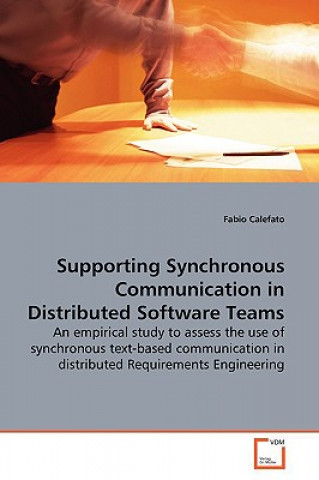
Among the software development activities,§requirements engineering is one of the most§communication-intensive and then, its effectiveness§is greatly constrained by the geographical distance§between stakeholders. For this reason, the need to§identify the appropriate task/technology fits to§support teams of geographically dispersed§stakeholders plays a key role for coping with the§lack of physical proximity when developing requirements.§Building on an extensive review of the very many§existing theoris on computer-mediated communication.§This dissertation reports on an empirical study that§assessed the use of synchronous text-based§communication in distributed requirements workshops,§as compared to face-to-face (F2F), and the effects of§computer-mediated communication (CMC), with§respects to the different tasks of distributed§requirements elicitation and negotiation. Results§show that, in terms of satisfaction with performance,§CMC elicitation is a better task/technology fit than§CMC negotiation. Furthermore, the general§preference for F2F over CMC is due to the strong§preference for the F2F negotiation fit over the CMC§counterpart.