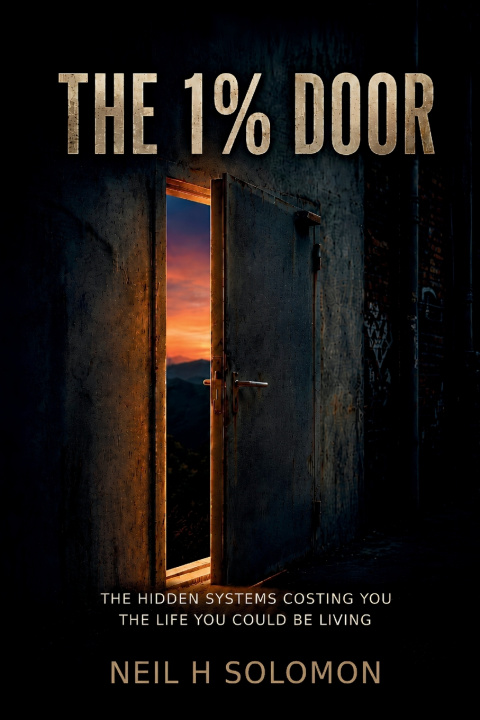
At 40, a Fortune 500 employer paid Neil H. Solomon a $13,000 bonus on $6.5 million of revenue he had personally produced.
That check did not end his career. It opened a door he had walked past for years.
After nearly dying in a river in Costa Rica, Neil spent almost twenty years chasing one question:
Why do some people see opportunity everywhere, while others never see it at all?
The answer wasn't talent, money, or luck. It was perception.
Most of us live inside hidden architectures, invisible systems that quietly decide where we live, what we fear, how we work, what we owe, and what we believe is possible. We don't choose them. We inherit them. And we pay for them every day, in costs we never see.
The 1% Door is the story of what came next: the exit, the seven-year winter, the businesses built and lost, the deals made, the collapse that followed, and the rebuild in another country with a different currency.
It is also a different way of seeing.
Built from entrepreneurship, business systems, real estate investing, buying a business, partnerships, collapse, recovery, financial freedom, wealth building, money mindset, and international living, this book shows you how to spot the systems shaping your life, name what they are quietly costing you, and find the door you have been walking past.
This is not a traditional business book, a simple self-help book, or a typical business memoir. It is a guided way of seeing for readers questioning career change, corporate burnout, financial independence, and the default life they were taught to accept.
Inside this book, you will see:
- Why most people do not have an effort problem. They have an architecture problem.
- How hidden systems shape money, work, fear, family, location, and opportunity.
- What business, deals, partnerships, and failure can teach about freedom.
- Why waiting to live until retirement, until the kids graduate, or until things settle can become its own prison.
- How changing the country, currency, structure, or default can change the cost of an entire life.
- Why the path to a different life begins with perception, not permission.
Page by page, Solomon shows that fear is often inherited rather than examined, that money mindset is not about slogans but structure, that business failure can reveal more than business success, and that the door most people are waiting for may have been open the whole time.
Most people don't have an effort problem.
They have an architecture problem.
Solomon isn't a guru. He saw that the door was open, walked through, and came back so you could see it too.
"There is another room. The door was never locked. Most people never walk through. You can. I did. I'll show you where I found it."