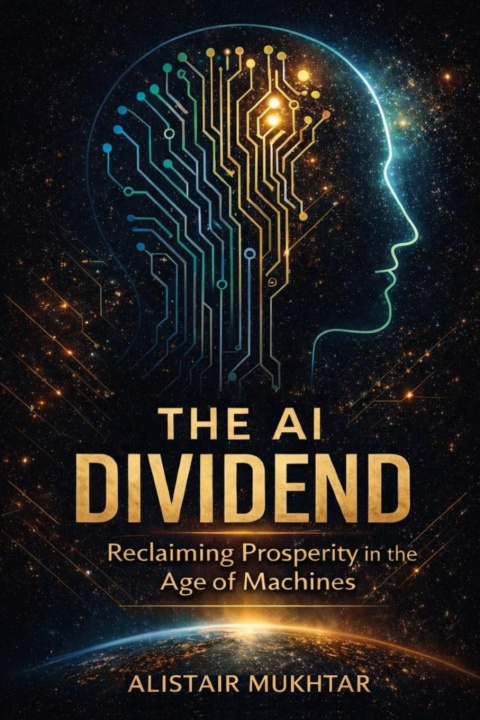
The Age of the AI Dividend
Why the Future of Prosperity Depends on What We Do Next
Artificial intelligence is transforming the world faster than any technology in history. It writes, designs, analyzes, diagnoses, and decides. It boosts productivity, slashes costs, and generates unprecedented corporate profits. But here's the uncomfortable truth:
As machines do more of the work, wages stagnate. Entry-level jobs disappear. Opportunity narrows. The social contract that once tied hard work to upward mobility is unraveling.
The Age of the AI Dividend confronts the defining economic question of the 21st century:
If machines can now earn, who should share in the wealth?
In this bold and deeply researched manifesto, Alistair Mukhtar argues that artificial intelligence does not have to mean mass unemployment, permanent inequality, or a future owned by a handful of tech monopolies. Instead, AI can become the foundation of a new social contract - one that distributes prosperity instead of concentrating it.
This book moves from crisis to solution in three sweeping parts:
Part I - The CrisisHow automation is breaking the promise of work, erasing career ladders, and severing the link between productivity and wages.
Part II - The OpportunityA blueprint for redesigning the system:
The Four-Day Workweek
Tax reform for a post-work economy
Taxing automation instead of labor
Reindustrialization powered by AI
A value-based immigration strategy
Part III - The TransformationHow to turn machine profits into shared prosperity through:
Sovereign wealth funds
Universal healthcare decoupled from employment
A universal birthright endowment
Early retirement funded by automation gains
Rather than relying on universal basic income alone, Alistair Mukhtar proposes something more ambitious: public ownership of AI-driven wealth. When citizens own a stake in the technologies built from collective data and intelligence, automation becomes an engine of shared security rather than displacement.
Grounded in economics, history, and policy design, The Age of the AI Dividend is neither dystopian nor utopian. It is pragmatic. It argues that technology is not destiny - policy is.
This is a book about time, dignity, and the future of work. It is about converting efficiency into freedom. It is about ensuring that when machines thrive, humanity does too. The automation age is here. The question is whether it will divide us - or enrich us all.
Welcome to the AI Dividend.