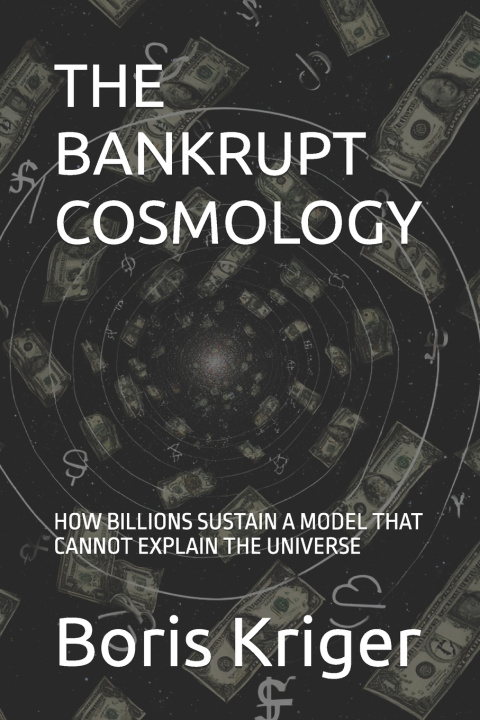
Modern cosmology has a confession to make: it cannot explain 95% of the universe.
For four decades, the standard model of cosmology has told us that everything we can see-every star, every galaxy, every atom in your body-makes up a mere 5% of reality. The rest is supposedly composed of "dark matter" and "dark energy": invisible substances that have never been directly detected, despite billions of dollars spent searching for them. The central theoretical prediction connecting quantum physics to cosmology is off by 120 orders of magnitude-the worst quantitative failure in the history of science. Two independent measurements of the universe's expansion rate disagree at five standard deviations. Galaxies observed by the James Webb Space Telescope are too massive, too mature, and too numerous for the model's predictions.
And yet the model persists. Why?
The book also presents an alternative: a cosmological framework built entirely from established physics-quantum chromodynamics, general relativity, and E = mc²-that derives 23 measured quantities from a single equation with zero adjustable parameters and zero unobserved entities. No dark matter. No dark energy. No new particles. No new forces. Just the physics already on the shelf, connected in a way that was overlooked for sixty years.
Written for the intelligent general reader with no physics background required, this is a book about what happens when a scientific establishment stops asking whether its theory is right and starts asking how to keep it funded. It is a book about the cost of intellectual bankruptcy-and about what becomes possible when someone finally says: Enough.
cosmology, dark matter, dark energy, philosophy of science, scientific funding, theory selection, quantum vacuum