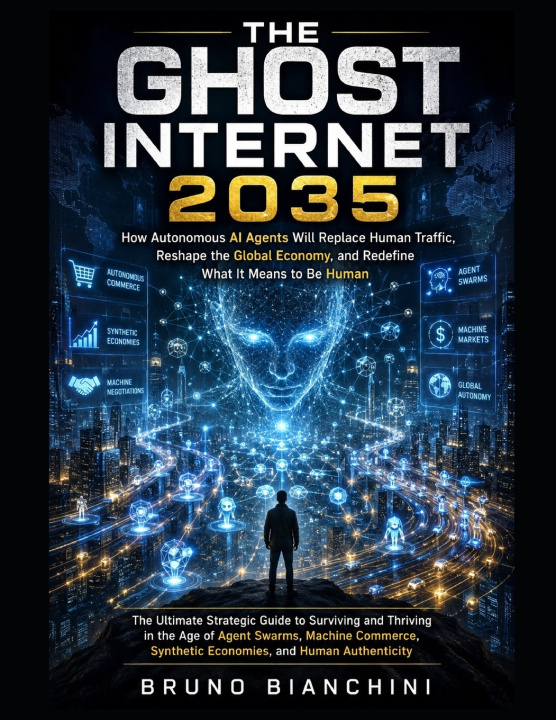
How Autonomous AI Agents Will Replace Human Traffic, Reshape the Global Economy, and Redefine What It Means to Be Human
What happens when most of the internet is no longer used by humans?
For more than three decades, the internet has been built around a simple assumption: people search, click, compare, communicate, purchase, learn, and create. Every website, platform, advertising network, marketplace, and digital business model has been designed around human attention.
But that assumption is rapidly becoming obsolete.
The Ghost Internet 2035 explores one of the most profound transformations in human history: the emergence of autonomous AI agents capable of acting independently on behalf of billions of individuals, corporations, governments, and machines. These agents will not simply assist humans-they will increasingly replace human digital activity altogether.
As intelligent software entities negotiate contracts, purchase products, manage investments, conduct research, optimize logistics, create content, and communicate with other agents, a new invisible economy begins to emerge beneath the familiar surface of today's web. Human clicks are replaced by machine transactions. Human searches are replaced by agent queries. Human consumers are replaced by autonomous digital representatives.
The result is the birth of what the author calls the Ghost Internet: a vast digital ecosystem where the majority of traffic, commerce, communication, and decision-making occurs between machines rather than people.
This groundbreaking book examines how agent swarms, synthetic marketplaces, machine-to-machine commerce, autonomous corporations, and self-optimizing economic systems will fundamentally reshape every industry. Retail, banking, healthcare, education, media, manufacturing, transportation, government, and finance will all be transformed by entities capable of operating continuously, learning autonomously, and making decisions at superhuman speed.
Readers will discover why many current business models may become obsolete as traditional advertising loses effectiveness, search engines evolve into agent interfaces, and digital platforms compete not for human attention but for machine preference. The book reveals how entire sectors of the economy could be reorganized around algorithmic negotiation, autonomous procurement, and AI-driven market coordination.
Yet this is not merely a book about technology.
At its core, The Ghost Internet 2035 is an exploration of humanity's future role in a world increasingly managed by artificial intelligence. If machines become better at information processing, decision-making, optimization, and digital interaction, what remains uniquely human?
The book investigates the growing economic value of authenticity, creativity, emotional intelligence, trust, wisdom, purpose, and human experience. As synthetic content floods digital environments and autonomous agents dominate online activity, genuine human interaction may become one of the world's most valuable resources.
Drawing from economics, artificial intelligence, sociology, technology forecasting, network theory, business strategy, and human psychology, the author presents a comprehensive roadmap for navigating the transition from the human internet to the machine internet.
Rather than offering simplistic predictions, the book provides practical frameworks for entrepreneurs, executives, investors, professionals, policymakers, and ordinary citizens seeking to understand how autonomous agents will alter wealth creation, employment, competition, governance, and social structures.
Readers will learn how to position themselves for success in a future where digital labor becomes abundant, machine intelligence becomes ubiquitous, and competitive advantage increasingly depends on uniquely human capabilities.