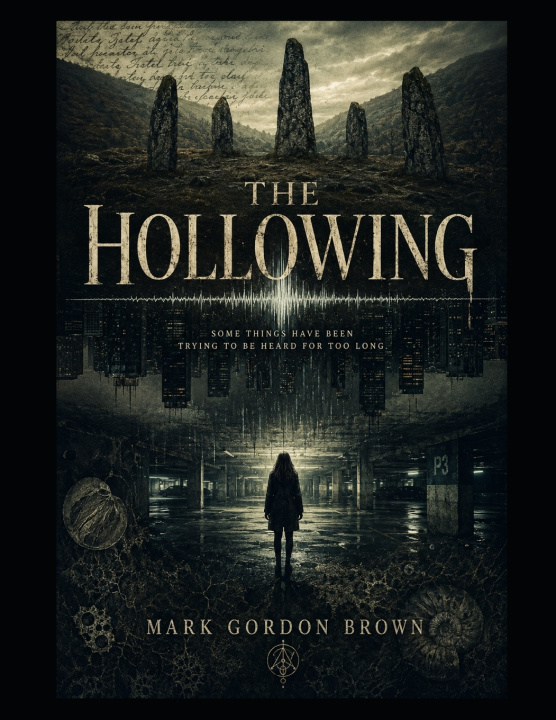
Erasmus Vane walked into an Appalachian valley in 1847 and sat down between seven standing stones because something underneath them was speaking, and he could not make himself stop listening.
A hundred and seventy years later, Nadia Clearwater wakes up in a Chicago parking garage at three in the morning with no memory of how she got there. It is not the first time. Her grandmother left her a leather pouch, a short letter, and one instruction: listen, and do not try to make it into anything.
What Nadia is hearing did not begin with her, and it will not end with her. It is older than language, older than the limestone four hundred million years beneath Chicago's streets, and it has been trying to be heard since before there were ears built to receive it. It has a frequency. It has a history. And in the deep places where its signal has gone unanswered for too long, it has started to grow things that the witnesses who found them had no good name for.
THE HOLLOWING moves through American time the way its subject does: backward and sideways as much as forward. It opens in ornate, haunted Gothic prose, drops without warning into the flat voice of a woman trying to explain her own disappearing hours to a friend over coffee, and ends somewhere stranger still, in language that has stopped being entirely English. Cryptid sightings, sub-audible seismic readings, a federal visit nobody asked for, and a network of strangers across the continent who all started hearing the same thing in the dark all converge on one impossible question: what happens when something this old finally gets heard all the way through.
This is a novel about deep time, inherited obligation, the cost of being listened to, and the things that live in the seam between what the earth is and what it has made.
For readers of weird fiction, cosmic horror, and literary folk horror who want their dread slow, geological, and unresolved.