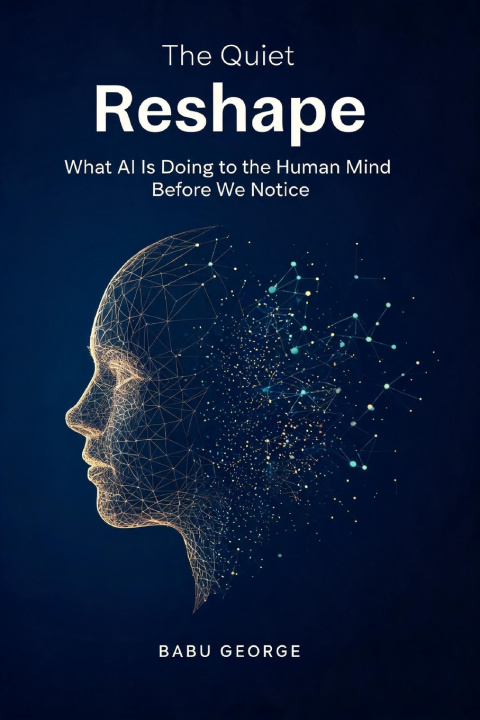
The Quiet Reshape argues that the most consequential effect of artificial intelligence is not the essays, images, or code it generates, but the slow reshaping of the minds that use it. Drawing on a personal encounter with people in rural India who have never used these tools, and on thinkers from Plato and Walter Ong to Marshall McLuhan and the philosophers of the extended mind, the book makes the case that thinking alongside a machine leaves a durable residue, a cognitive sediment, that persists even when no machine is present. It traces how this particular tool gets inside human cognition through conversation itself, catalogues the cognitive style it deposits, and follows the consequences out into authorship, education, memory, and the homogenization of human thought into a single efficient average. It closes with a practical philosophy of cognitive ecology and an argument for a deliberately built next literacy. Written for the general reader rather than the specialist, it is for anyone, in education, technology, or ordinary life, who senses that something is shifting in how we think and wants language adequate to name it.