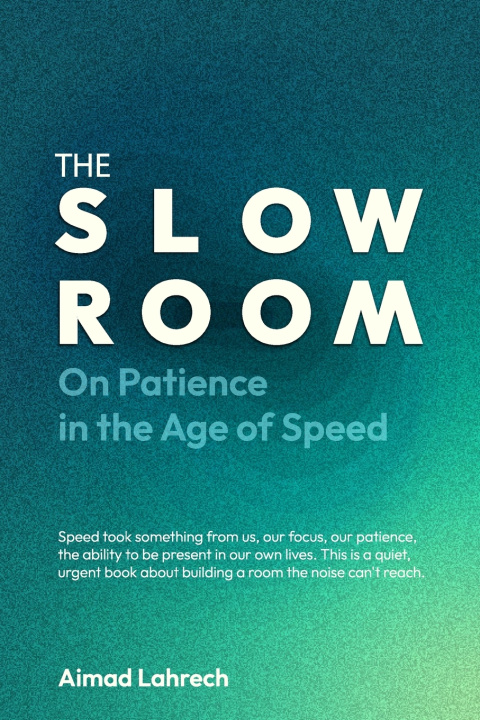
We kept the freedom and lost the patience.
You used to be able to read for an hour without reaching for your phone. Sit through a film. Stay in a hard conversation without wanting to escape. Somewhere in the last thirty years - quietly, and without your permission - those abilities thinned. And almost nobody noticed it happening.
The Slow Room is a calm, unflinching account of how we were trained out of our patience, and what it has cost us: in our work, our friendships, our marriages, and our sense of who we are. Drawing on neuroscience, psychology, and the research of figures like Anna Lembke, Johann Hari's sources, Sherry Turkle, and the scientists who built artificial intelligence and now fear it, it traces a single thread through the whole of modern life - the slow disappearance of our capacity to wait, to focus, to stay.
But this is not another book that ends in despair.
Because as AI enters our lives, it will not save us and it will not doom us. It will do something stranger: it will amplify whoever we have already become. To the patient and present, it offers extraordinary power. To the scattered and depleted, it offers a faster way to disappear. The difference is not in the machine. It is in us.
And patience, it turns out, is not a virtue you are born with or without. It is a capacity - one the brain can rebuild, at any age, the same way a muscle returns with use.
The Slow Room is a book about getting it back. About building, in the middle of the fast world, a room the noise cannot reach.
The door is still open.