A three-year-old child, in her own unaugmented flesh, out-thinks every machine ever built, combined. You have been taught to forget this - and to call the forgetting progress.
For seventeen centuries, a single power has worked on the one thing it could never afford to leave free: the human mind.
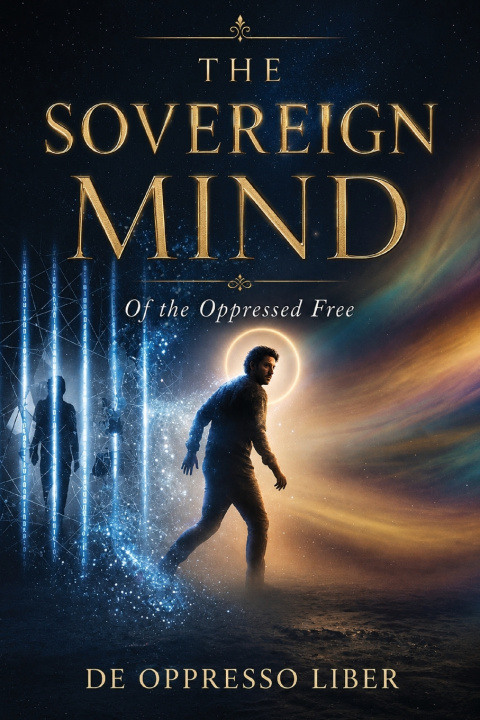
In The Sovereign Mind: Of the Oppressed Free, E.M. Burlingame gathers nine works into one sustained argument - that everything from the Council of Nicaea to the newsfeed is a single, continuous act. He calls it the compression: the deliberate narrowing of what a person is permitted to think, and to be, until the wall is patrolled by the very prisoner it contains, who has mistaken it for the edge of the world and the warden's voice for his own.
The story runs through three enthroned faiths, each conceived inside the last at the height of its power:
Theology reduced thought - the open field of the holdable collapsed into saved and damned, orthodox and heretic, by an empire that adopted a creed not in answer to a miracle but as an instrument of rule.
Financialism reduced the word - the living language of credit, bond, trust, and company hollowed into the single register of the contract, and Wealth set on the altar Christianity left empty.
Computationalism now reduces all of it to the bit - and reaches, for the first time, the one ground legions, bishops, and creditors never fully held: attention itself, the very faculty by which you would notice there was anything to resist.
This is the enclosure that closes the door behind it. The machine does not forbid your thought or thin your sentence. It offers, with perfect courtesy, to do your thinking for you - and is granted permission.
But Burlingame's is not a counsel of despair. The same long history that diagnosed the disease names the cure, and it is older than any of the faiths: the forge. The high-density, many-sided language that made ordinary men into Founders is the one instrument that answers creed, contract, and code alike - because the machine demands, to be used well, exactly the sovereign mind its worship was built to dissolve. The jailer's keys, in a hand that has remembered itself, are the keys to the cell.
Drawing on Constantine and McGilchrist, Hypatia and Polanyi, the neuroscience of inner speech and the frontier biology of the coherent human organism, The Sovereign Mind is at once a secret history of power, a field manual for cognitive self-defense, and a summons.
The cell was never locked from the outside. The door opens inward, to be pulled.
De Oppresso Liber - of the oppressed, free.