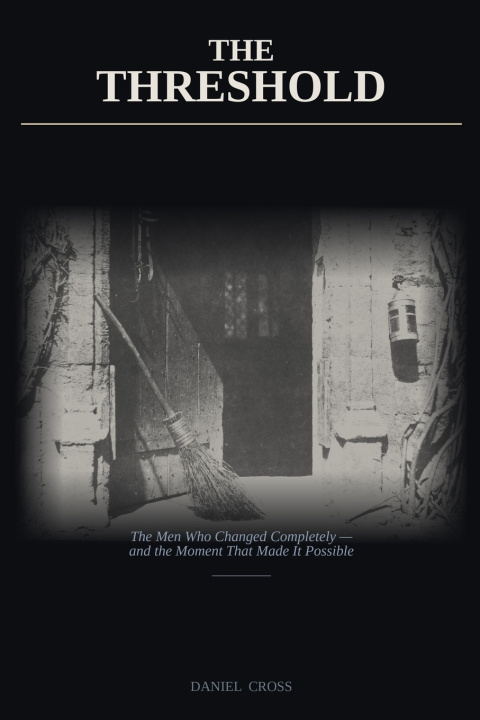
Every man who has ever changed completely passed through the same invisible door. Here is what that door looks like.
They can describe the before. The career that felt like a corridor with no exit, the life assembled from other people's expectations, the restlessness that good circumstances didn't quiet. And they can describe the after - the clarity, the work that actually mattered, the second chapter that felt, finally, like their own.
But the threshold itself - the actual moment when the transformation became irreversible - almost always gets described in the language of mystery. I just knew. Something broke open. I couldn't go back.
The Threshold Argument is the book that names the mechanism.
Drawing on sixteen centuries of documented threshold crossings - from a garden in Milan in AD 386 to a tennis court in the 1990s - this book examines fourteen men who not only changed completely, but left unusually precise records of what crossing felt like from the inside. Not polished retrospective narrative. The raw account, written or dictated before it had been smoothed into legend.
The fourteen men:
- Augustine of Hippo - who wept under a fig tree for thirty-one years of postponed transformation, then crossed in a single second
- Fyodor Dostoevsky - who stood before a firing squad believing he was about to die, and found out what actually mattered
- Frederick Douglass - who heard his enemy explain the mechanism of his own captivity, and used that explanation as a map
- William James - who was philosophically paralysed for three years and crossed his threshold with a diary entry and a philosophical wager
- George Orwell - whose bullet and betrayal in Spain made dishonesty permanently impossible
- Leo Tolstoy - who had everything the world said was the answer, and found that it wasn't
- Carl Jung - the only man in history who went into the liminal state deliberately, stayed for six years, and came back with a theory of it
- Viktor Frankl - whose wife's face arrived on a death march, and became everything
- Malcolm X - who transformed twice, twelve years apart, the second time at the peak of everything, when the cost was highest
- Nelson Mandela - who spent twenty-seven years in a cell building, one Afrikaans sentence at a time, the understanding that would change a country
- Ray Kroc - who found his life's work at fifty-two, in a parking lot in California, after thirty years of preparation he hadn't known was preparation
- James Baldwin - who needed an ocean between himself and America before he could describe it honestly
- Anthony Hopkins - who heard a voice at eleven o'clock on December 29, 1975, and the craving left and never returned
- Andre Agassi - who spent twenty years performing an identity he had never chosen, in a sport he hated, before he found out whose story he was actually living
Each chapter opens at the threshold moment itself, then examines the corridor that preceded it, the psychology that explains it, and the principle transferable to any reader standing in front of a similar door.
This is not a framework book. There is no programme to follow, no steps to complete. There is a structure - the same structure in all fourteen crossings, across sixteen centuries - and within that structure, there is a vocabulary. The ability to name what is happening when it is happening is, it turns out, one of the most practically useful things available to a man in the middle of a threshold crossing.
For readers of Man's Search for Meaning, Open, Can't Hurt Me, and The Obstacle Is the Way.
Daniel Cross writes narrative nonfiction at the intersection of psychology, history, and personal transformation.