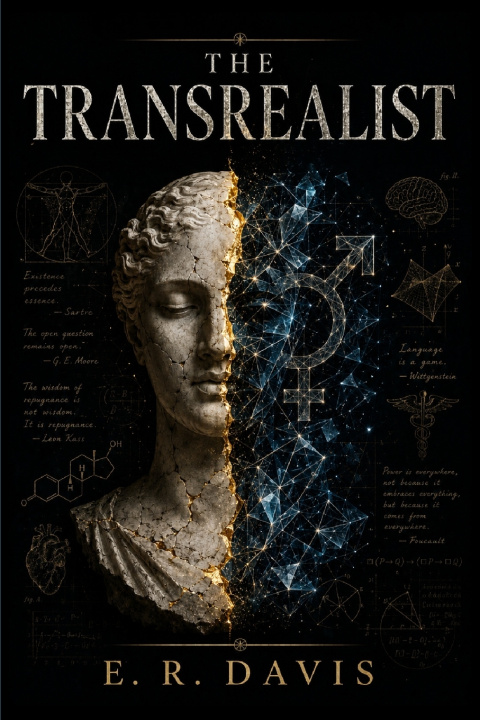
The Transrealist is a work of philosophy in the oldest and least comfortable sense: not a survey of positions, but a verdict on them.
E. R. Davis identifies three doctrines currently competing to explain transgender existence, and argues that all three are the same failure wearing different masks. The Puritan (gender-critical feminism and bioconservatism) mistakes her own fear for a law of nature. The Priest (clinical transmedicalism) built a confessional out of a real condition and made himself its indispensable gatekeeper. The Nominalist (self-identification without criterion) emptied the category of everything that made it worth having, and handed his opponents their strongest evidence in the process. Each substitutes something else, a given, a signature, a word, for the one thing none of them actually requires: gnosis, lived knowledge from inside the condition, checked afterward against evidence rather than against a doctrine's convenience.
Structured as four books in The Transrealist moves from demolition to testimony. Books One through Three take on the Puritan, the Priest, and the Nominalist in turn, drawing on Audre Lorde, Shulamith Firestone, Wittgenstein, Foucault, Kripke, Judith Butler's actual (rather than vulgarized) arguments, and Julia Serano's Whipping Girl, alongside the legislative record of Pink Laws now spreading across the anglosphere. Book Four sets the polemic aside and offers something rarer: a phenomenological first-person testimony of gender dysphoria, cross-examined against the neuroscience of prenatal brain development, hormone-receptor mismatch, and population-level outcome data, a philosophy that survives the same scrutiny it turns on everyone else.
This is not a book that asks to be liked. It asks to be checked. It does not pity its opponents, and it does not spare its own side's comfortable failures either. What remains, after four books of demolition, is not an argument seeking permission. It is a record of what was already true.
For readers of philosophy, gender studies, and polemical nonfiction, and for anyone tired of being told that the truth of their own body requires someone else's signature.