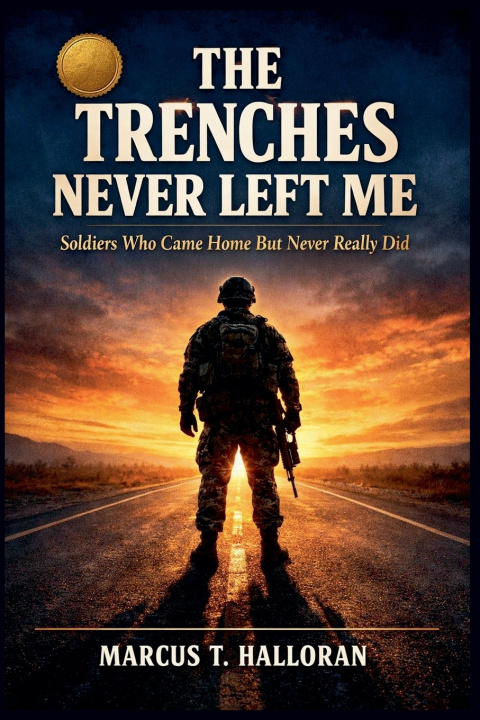
He survived the war in eighty one days. He spent the next fifty years surviving the homecoming.
This is not another book about battles. It is the book about what happens after the battle ends, and nobody tells you the second war, the quiet one, has just begun.
Across five conflicts and more than half a century, from a slit trench outside An Khe in 1968 to a collapsed building in Aleppo in 2016, this book follows the people history mostly forgets to check on once the cameras leave: the soldier who came home to an airport full of strangers who hated his uniform, the Gulf War veteran who waited thirteen years to be believed, the Marine who carried three roadside blasts in his skull for five years before anyone thought to look, the interpreter left on a tarmac while the country that promised him a future boarded its last plane out.
You will meet Daniel, who learned that surviving combat and surviving the fifty years afterward are two entirely different feats of endurance. You will meet Renata, whose war lasted one hundred hours and whose recovery took three decades, because nobody believed a short, victorious war could break a person this thoroughly. You will meet Theo, whose brain carried an invisible wound that medicine had not yet learned to see, and Wyatt, who deployed four times and came home each time a little less able to put himself back together. You will meet a volunteer who fought a war that was never hers to fight, and a photographer whose camera remembered more clearly than he did.
None of them are case studies. They are written the way a friend would tell you about someone they cannot stop thinking about, with the pacing of a novel and the conscience of a war correspondent. Every statistic in these pages is real. Every treatment described is one doctors actually use. Every helpline listed will actually pick up the phone. This book does not invent a single number to make the story land harder, because the truth, once you see it laid out in full, lands hard enough on its own.
What makes this book different is not just its scope, five wars instead of one, but its refusal to let any single conflict have the last word on what trauma looks like. War does not change personalities. It rewires nervous systems, and it does so the same way whether the uniform is American, foreign, or nonexistent, whether the weapon was a rifle or a camera, whether the war lasted twenty years or four days. By the final chapter, you will understand exactly why the most composed, most functional looking person in any room might still be fighting a war nobody else can see, and exactly what the evidence says actually helps.
You will not read this book the way you read most nonfiction, a chapter here, a chapter there, returned to over a week. You will read it the way you read a story you cannot put down, because that is how it was built, chapter by chapter, scene by scene, fact by fact, until the last page asks you the only question that matters: now that you know, what will you do with it.