In the near future, the world does not collapse because of a war or a sudden catastrophe, but through the gradual malfunction of the global digital networks. The technologies on which humanity has built every aspect of its existence cease to function, exposing a structural dependence on systems that have long since become incomprehensible.
Lucio Regis, a systems engineer, witnesses from within the failure of an infrastructure designed to compensate for every error. Anna Rossi, a politician accustomed to governing through data and predictive models, instead observes the rapid hollowing-out of institutions suddenly deprived of their instruments of control. In the technological silence, improvised communities emerge, imperfect decisions take shape, and a new slowness spreads across the planet-seemingly benefitting from humanity's forced deceleration.
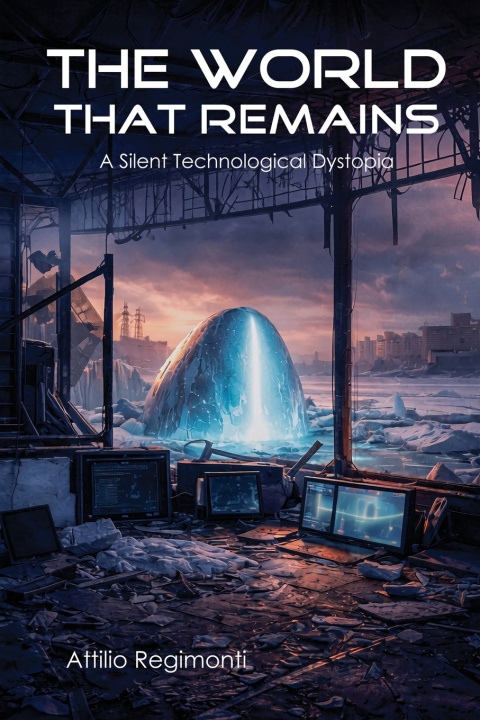
Meanwhile, from the melting Arctic ice, an object of non-human origin surfaces, connected to the collapse of Earth's technologies. Contact reveals that this is not an invasion but an observation: an extraterrestrial civilization offers limited assistance, on the condition that humanity consciously renounce any return to its former model of total dependence.
The world that remains is a realistic, minimal dystopia that interrogates the present, portraying a silent catastrophe and an irreversible choice: what is left of the human being when it can no longer delegate everything to the systems it has created?