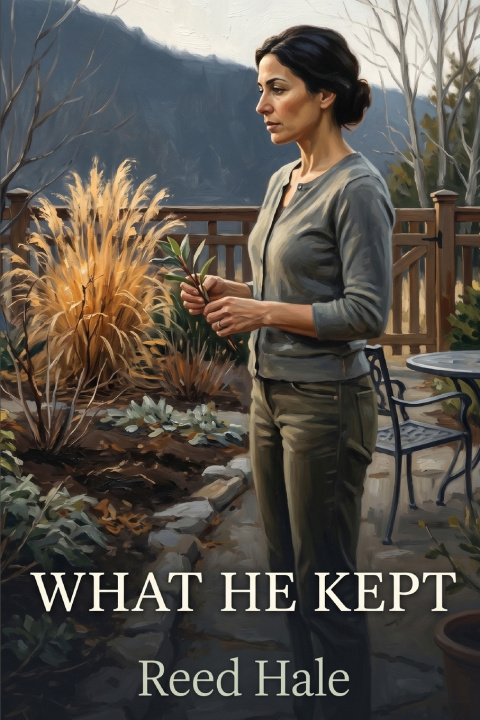
He loved them both. He told them both the same story. Now he is gone, and neither woman can answer the question the other most needs answered.
On a Tuesday night in October, Daniel Davis drives Route 74 between Asheville and Charlotte: the road he has driven for six years, in both directions, between two complete and inhabited lives. At 11:47 PM, his car leaves the eastbound lane. He does not survive.
By Wednesday morning, two women have received the same phone call. Lauren, a landscape architect in Asheville, has been his wife for nine years. Meg, an art teacher in Charlotte, has been his wife for six. Neither knows the other exists. They arrive at the same hospital, walk toward the same consultation room, and find two chairs placed at a slight angle that is not quite facing each other.
What follows is not a confrontation. It is something the language does not have a word for. Lauren and Meg have no name for what they are to each other. They are the only two people on earth who know exactly what the other has lost. The estate proceedings that follow will require them to position themselves as adversaries. Neither of them quite manages it.
Daniel genuinely loved them both. He told them the same stories: the same specific windows into himself, delivered in the same words at the same emotional timing, the same pause before the moment of understanding. He remembered what each woman mentioned once and brought it back weeks later, proof of attention so complete it felt like being known. He was entirely present whenever he was present, and that quality of full attention was what made each woman feel the absences were simply the cost of a demanding career, not the architecture of something else. He was neither calculating nor cold. He was a man who loved two people and could not choose, who had learned since boyhood to manage complexity through compartmentalization and had, for years, mistaken that capacity for a form of care.
Now the estate attorneys have legal answers. North Carolina law has legal answers: Lauren is the legally recognized widow; Meg's marriage, performed while his first was still intact, is void under state law. Neither woman finds that the legal answer touches what they actually lost.
Told in two voices, What He Kept moves between Lauren's present-tense reckoning from the morning after Daniel's death and Meg's retrospective narration of a marriage she is only now learning to see whole. Lauren is the competent one, a woman who converts impossible things into next steps and has never let a difficult situation stay unmanaged for long. She is very good in a crisis. Meg is the warm one, a woman who loved without reservation and gave her husband the benefit of every doubt, who saw a question forming in her mind and chose not to ask it. Both of them, the reader comes to understand before either character does, chose not to look at certain things. Both paid for that choice.
The novel asks what you do with a love that was genuine and a lie at the same time. It does not answer. It makes the unanswered question feel true rather than evasive.
The coffee shop was crowded on a Saturday afternoon, and he found me a table near the back before he ordered. He remembered that I hated waiting at the counter. I had mentioned it once, in September. It was January. I thought: okay. Okay. I thought: this is the kind of man who pays attention. I thought a lot of things in those first months that I have spent a year and a half unthinking, one at a time, late at night, when Willow is asleep and the house is quiet and I am the only person left who has to decide what any of it meant.
For readers of Liane Moriarty, Lisa Jewell, and Celeste Ng: a novel about what we choose to see, what we choose not to, and what remains when the choice is no longer ours to make.