What does it mean to call something artificial?
When you sit down with an AI system and produce something-a decision, a document, a design, a strategy-after guiding its output, applying your judgment, redirecting when it goes wrong, and taking responsibility for what comes out the other end: what, exactly, is artificial about that?
That is the question at the center of this book.
The label "artificial intelligence" may be the most consequential naming decision in the history of technology. It shapes how we regulate AI, how we govern it, how we use it, and most importantly, how we understand what we are doing when we work with it. And it may be getting the most important thing wrong.
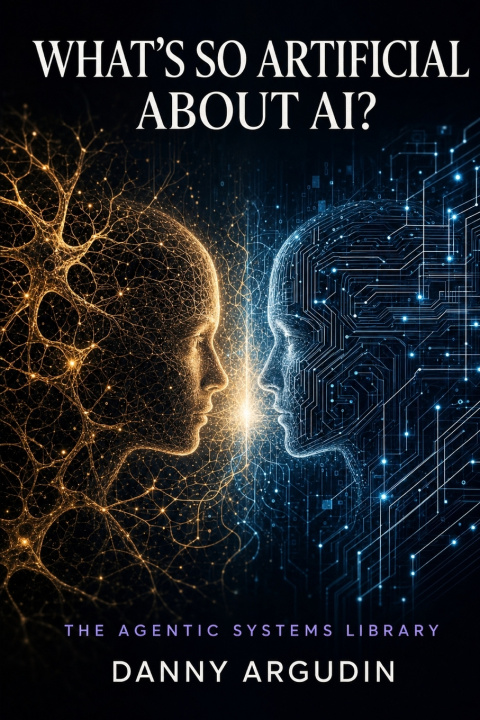
Danny Argudin argues that the word "artificial" points at the wrong part of the system. Language models are not artificial thinkers. They are compressed patterns drawn from the full corpus of human thought-encoded mathematics, not invented sentience. What they produce when guided by a skilled human collaborator is not an artificial substitute for intelligence. It is intelligence extended.
At the heart of the book is a distinction that changes everything: resident vs. non-resident intelligence.
The resident intelligence is you. You have stakes. You will face consequences. You can be held accountable. You bring judgment that costs something when it is wrong.
The non-resident intelligence is the AI. It has no skin in the game. It cannot be hurt by a bad decision. It processes without consequence.
This is not a limitation to overcome. It is the design. And once you see the distinction clearly, the question answers itself.
A composer who uses an orchestra is not producing artificial music. A designer who uses tools is not producing artificial design. A thinker who uses an AI is not producing artificial thought.
The orchestra plays. The tools shape. The AI processes. And the human-present, accountable, directing, deciding-is the intelligence that makes all of it mean something.
What You'll Find in This Book
- Where the term "artificial intelligence" came from-and what it was never meant to describe
- What large language models actually are at a level that changes how you use them
- Why the human-as-operator model is the wrong frame for AI collaboration
- The resident vs. non-resident distinction and why it matters for accountability, governance, and daily practice
- A new vocabulary for human-AI partnership: cognitive extension, not automation
- What the future looks like when we get the framing right
What's So Artificial About AI? is not a technical guide and not a hype manifesto. It is a reframing-careful, argued, grounded in the actual experience of working with these systems every day. By the end, the word "artificial" will look different to you. And so will the partnership you're building.