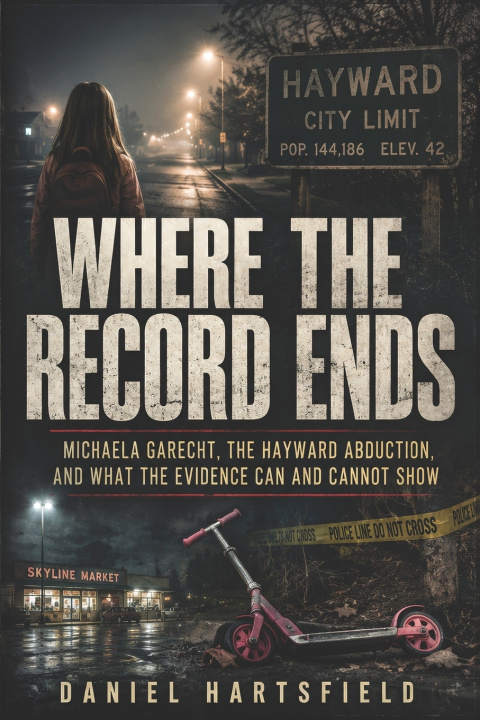
A child disappeared in daylight. Decades later, a charge gave the case a name-but not a verdict.
On November 19, 1988, nine-year-old Michaela Joy Garecht vanished from a market parking lot in Hayward, California. The public record began with a scooter, a childhood witness, a reported abduction, and a vehicle traveling south on Mission Boulevard. What followed was a decades-long missing child investigation marked by searches, public appeals, investigated leads, family endurance, and questions the available evidence still cannot fully answer.
Where the Record Ends reconstructs the Michaela Garecht case as evidence-aware narrative nonfiction. It follows Michaela before she became a missing-person image, the ordinary Saturday route that led to the market, the first alarm, the flood of leads, the years without recovered remains, and the legal turn that arrived more than three decades later.
In 2020, David Emery Misch was charged in connection with Michaela's abduction and alleged murder. The book examines that charge without treating accusation as proof. It also addresses his convictions in separate homicide cases while maintaining the essential legal distinction: those convictions do not, by themselves, establish guilt in Michaela's case.
At the center of the later case are difficult questions about evidence. What can partial palm or fingerprint evidence associated with a child's scooter show after decades? How should reported witness identification be weighed after more than thirty years? What happens when the defense challenges forensic reliability, preservation, identification procedures, and alternate explanations? And how can a murder charge be evaluated when no remains, public autopsy, or publicly identified murder scene completes the physical record?
Drawing on publicly available information, official statements where available, credible reporting, family statements made publicly, and public legal reporting, the book separates confirmed fact from reported information, allegation, dispute, interpretation, and speculation. It does not invent private dialogue, imagined final moments, or certainty where the sources do not support it.
The investigation is also the story of what a family and community are asked to carry when a child remains missing for decades. Michaela stays at the center-not as a symbol, a clue, or a vehicle for sensationalism, but as the nine-year-old child whose ordinary day became a public record with enduring limits.
Written in a restrained, victim-respectful style, this historical true crime account includes a detailed timeline, key-people glossary, and source index. It is for readers interested in missing persons cases, cold case investigations, forensic evidence, witness memory, no-body homicide prosecutions, and the boundary between public belief and legal proof.
Follow the record as far as it can responsibly go-and recognize where it must stop.