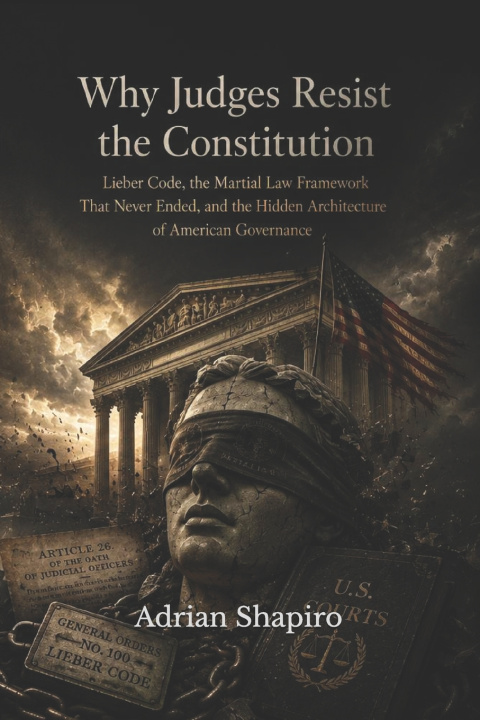
Every American who has ever watched a judge dismiss a constitutional argument without engaging it has witnessed something the mainstream legal establishment has never honestly explained. The standard answers - crowded dockets, frivolous arguments, settled precedent - collapse under examination. The pattern is too consistent, too directional, and too institutionally uniform to be explained by judicial error or docket management. Something else is producing it. This book identifies what that something else is, and traces it to a specific named primary source document that most Americans have never read.
General Orders No. 100 - the Lieber Code - was issued by President Abraham Lincoln on April 24, 1863, as the governing framework of martial law for the Union Army and all territories under its control during the Civil War. It established comprehensive military authority over civil governance, required civil officers including judges to take oaths of allegiance to the military authority as a condition of keeping their positions, and specified the exact conditions under which its martial law governance framework would formally cease. Those conditions were never formally satisfied. The Lieber Code was never formally rescinded. It sits today in the Library of Congress as an unrescinded general order of the United States Army, its cessation conditions unmet, its governance provisions unexamined by the mainstream legal establishment that would have the most to answer for if it examined them honestly.
This book examines what that means. It traces the Lieber Code's Article 26 oath provisions through the systematic application of loyalty oath requirements to state court judges during Reconstruction, through the Supreme Court's institutional accommodation to the military governance framework in the Reconstruction-era decisions, and through the doctrinal architecture of qualified immunity, constitutional avoidance, standing, ripeness, and harmless error that the Reconstruction-era accommodation produced. It examines the Law of Nations framework within which the Code's provisions operate, the UCC Article 7 warehouse receipt connection to the Code's private property indemnity provisions, the Reconstruction amendments and their ratification within the martial law governance structure, and the permanent emergency powers framework as the institutional expression of the martial law governance tradition the Code established.
Every connection is examined honestly, at exactly the level the specific named historical and legal evidence supports. Where the record is clear, the analysis says so. Where the evidence supports a reasonable investigative inference, the analysis says so. Where arguments extend beyond what the record establishes, the analysis says that too. This is not a book that tells readers what to believe. It is a book that assembles the complete historical and legal record and equips the reader to evaluate what that record means.
The question this book asks - why do judges resist the Constitution - has never been honestly answered by the mainstream legal establishment. The Lieber Code is the answer the mainstream has never given. It is available in the Library of Congress. It has always been available. It has simply never been examined. Until now.